Passing off of the Storm by John Frederick Kensett
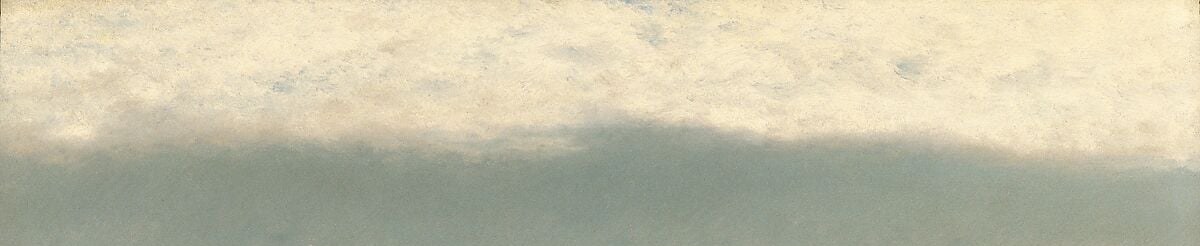
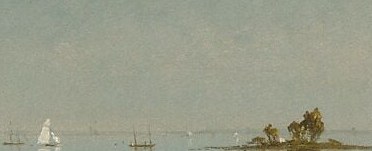
John Frederick Kensett’s "Passing off of the Storm" (1872) is a witness to a specific silence, the stillness that fills the air the moment a gale moves out to sea. Painted in the final year of the artist’s life, the canvas holds a sky still dissolving after violence, and a sea that has just exhaled.
Look first at the horizon. The storm is not coming, it is going. A faint pink-silver glow sits where the clouds are thinning, the only warm color in a field of soft gray. Below it, one white sail catches the returning light; the boat is small, upright, and already moving again. The water in the foreground is glass. Kensett does not show the storm, he shows its footprint.
Kensett was a core figure of the Hudson River School’s second generation and a founder of the Metropolitan Museum of Art. By 1872 he had moved beyond dramatic spectacle toward what became known as Luminism: spare, light-soaked compositions built on quiet geometry. This work is not a direct record of a place, it was likely painted in the studio, drawn from memory. The artist died that same year, and the painting’s introspection reads like a long, slow exhale.
What do you notice first, the light on the sail, or the stillness of the water?
Details



Transcript
The sea has just stopped fighting. The clouds are still pulling apart. Kensett painted this in 1872, the last year of his life. He was not outside. This is a memory of weather. That faint pink line is the storm leaving. One small boat has already raised its sail again.