My Bunkie by Charles Schreyvogel
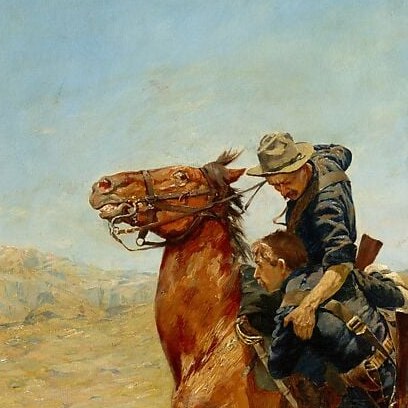
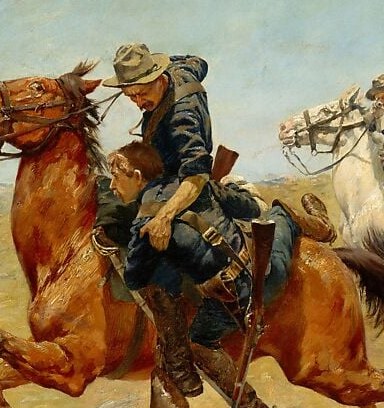
Charles Schreyvogel's 1899 oil painting, My Bunkie, hangs in the American Wing of the Metropolitan Museum of Art. It depicts a U.S. cavalry rescue on the vanishing frontier. The scene is chaos, but the title tells you the real subject: a bunkie is the soldier you share a tent with, the person closest to you in the field.
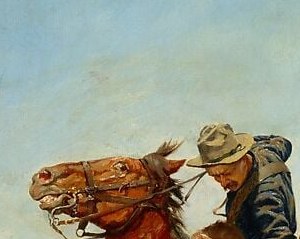
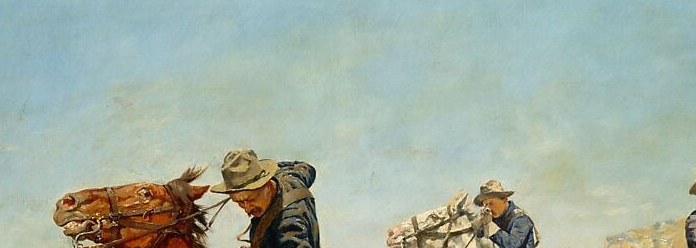
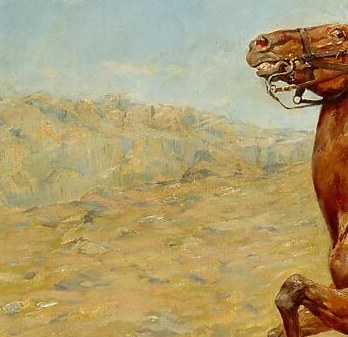
Look at the rescuer's face beneath the slouch hat. Schreyvogel gives him a set jaw and a downward focus that reads as grim duty, not panic. His outstretched arm is the hinge of the whole painting. Below him, the chestnut horse is captured in a full-extension gallop, a pose drawn directly from the Muybridge motion studies that were changing how painters understood animal movement in the 1880s. The white horse on the right carries a third soldier raising a rifle, holding off an enemy just outside the frame.
Schreyvogel was a New Yorker who never served. He earned his accuracy by living alongside cavalry troops for extended periods, sketching their drills, their gear, and the quiet rhythms of camp life. Veterans became his most vocal advocates, insisting he understood what the frontier actually felt like. His main rival, Frederic Remington, was both a friend and a critic, but Schreyvogel's attention to the emotional weight carried by ordinary soldiers gave his work a distinct charge.
My Bunkie is not a battle painting. It is a painting about the moment you realize no one is coming except the man beside you.
Details
Transcript
These three men are fighting an enemy you never see. The painter never served a day in uniform. He spent years living beside real cavalry troops to earn their trust. Veterans said he got it right. The strain. The noise. The speed. He called this painting My Bunkie. A bunkie is the man you share a tent with. The man reaching down is pulling his bunkie out of the fire.