The Sack of Jerusalem by the Romans by François Joseph Heim
François Joseph Heim's The Sack of Jerusalem by the Romans, painted in 1824, hangs in the Musée des Beaux-Arts de Rennes and depicts the Roman destruction of Jerusalem in 70 CE. It is a painting about imperial victory, but Heim makes the civilian cost impossible to ignore.
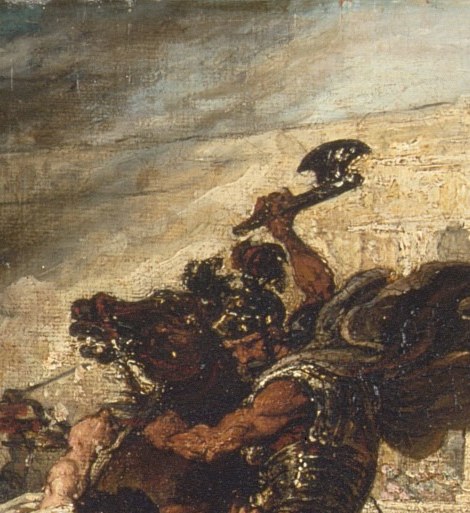
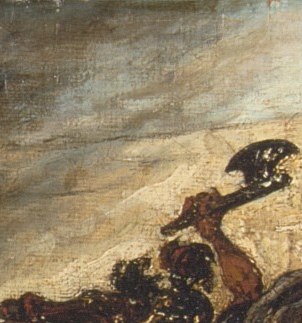
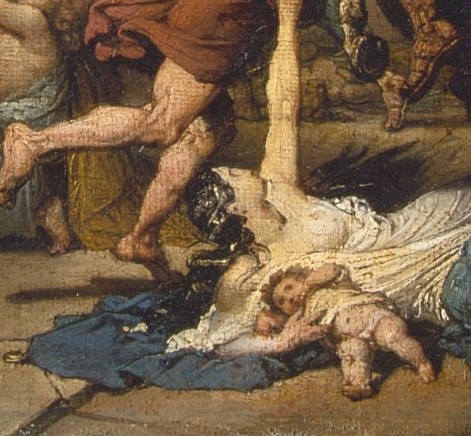
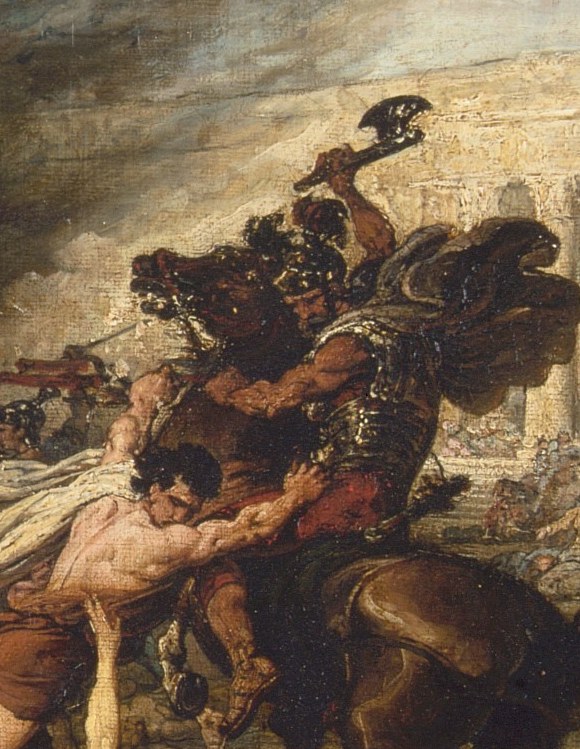
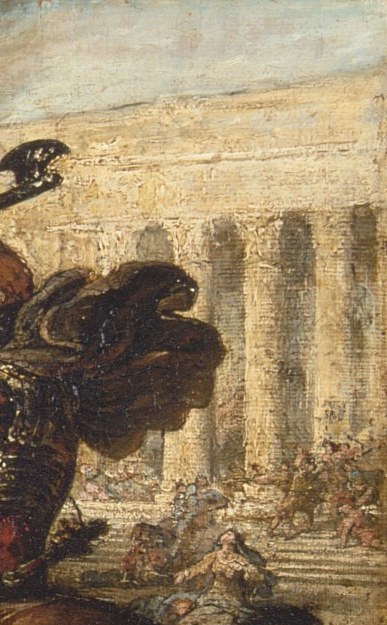
Your eye goes first to the mounted Roman general, his weapon raised against a smoky sky. Then it drops. At the bottom of the canvas, a mother has fallen. She braces herself on one arm and cradles an infant with the other, directly beneath the horse's raised hoof. Her face is the still point in all the chaos.
Heim submitted this enormous canvas to the Paris Salon in 1824, where large-scale history painting was still the highest category of art. The architecture in the background identifies the Temple Mount; the palm frond at the left edge is both a symbol of Jerusalem and of Roman triumph. But the painting does not celebrate. It mourns.
Every element of the composition, the rearing horse, the reaching hands, the bodies at the lower right, leads you back to that mother. Heim gave the victims of empire a face, and he gave it to a woman holding a child.
Details
Transcript
A Roman general commands the center of the scene. His raised arm signals triumph over a fallen city. Heim painted this for the Paris Salon of 1824. He was a celebrated French history painter. But the moral heart of the painting is down here. A mother, fallen, shields her infant with her own body. The horse's hoof is poised directly above them. Heim forces us to watch conquest from underneath.