At a Deathbed by Fritz Syberg
In Fritz Syberg's "At a Deathbed," painted in 1896, we witness a poignant and universal human experience. This oil painting, held at the Statens Museum for Kunst, captures a moment of quiet grief.
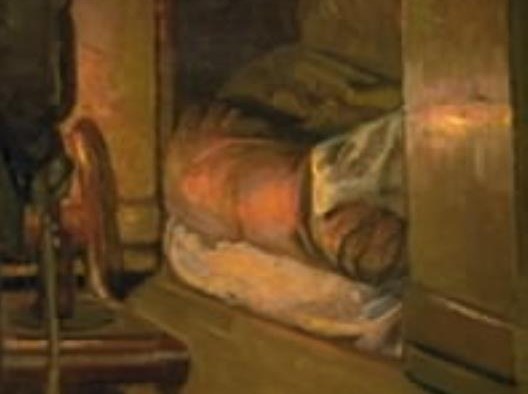
Syberg, a Danish painter associated with the Funen Painters, masterfully depicts the varied emotional responses of those gathered around a dying figure. Notice the hunched posture of the woman on the left, the clasped hands of the woman in the center, and the averted gaze of the man in the dark suit.
The artist's naturalist approach, characteristic of the Funen Painters, allowed him to portray everyday life with empathetic honesty, even its most difficult passages. His use of chiaroscuro draws the viewer's eye to the central figure, enhancing the scene's dramatic impact.
This painting invites us to reflect on shared human experiences and the quiet strength found in moments of sorrow. What emotions do these figures evoke for you?
Details




Transcript
This painter shows a universal human experience. In 1896, this scene was a common part of life. Observe the woman on the left, consumed by grief. Her hunched posture speaks to deep sorrow. The woman in the center clasps her hands in silent pain. A man stands nearby, a stoic observer. His averted gaze hides his thoughts. Each figure expresses loss in their own way.