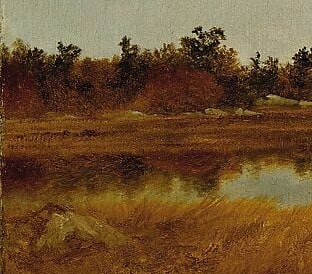
October in the Marshes by John Frederick Kensett
John Frederick Kensett's 'October in the Marshes' (1872) is housed in The Metropolitan Museum of Art, an institution he helped found. It is a late masterpiece of American Luminism, completed in the final year of his life, and it captures a coastal New England landscape with an almost sacred stillness.
Look first at the horizon. Kensett pushes the landmass to the very bottom of the canvas, surrendering the composition to an immense, pale sky. The marsh water beneath it acts as a perfect mirror, creating a vertical symmetry that nearly dissolves the boundary between earth and heaven. The warmest note in the painting is a narrow band of ochre reeds on the left bank, the 'October' of the title, the last color before winter mutes everything.
Kensett was a central figure in the second generation of the Hudson River School, but his mature work moved toward a quieter, more geometric spareness known as Luminism. This painting was completed in 1872, the same year he drowned while attempting to rescue a friend's wife from the waters off Long Island Sound. He was fifty-six.
The painting’s stillness reads differently with that knowledge. It no longer feels like simple observation. It feels like a final, sustained exhalation, a marshland holding its breath at the edge of a season, painted by a man at the edge of his own.
Details




Transcript
October, 1872. A New England marsh holds its breath. The painter is John Frederick Kensett. This is his final year. He pushes the land to the very bottom edge. So the sky can take over almost everything. This thin gold band of reeds is the 'October' of the title. The water is so still it becomes a second sky. Kensett drowned that same year, trying to save a friend's wife.