A Bashi-Bazouk by Charles Bargue
Charles Bargue's 1875 oil painting, *A Bashi-Bazouk*, exemplifies the 19th-century Orientalist movement, a period when European artists frequently depicted North African and Middle Eastern subjects.
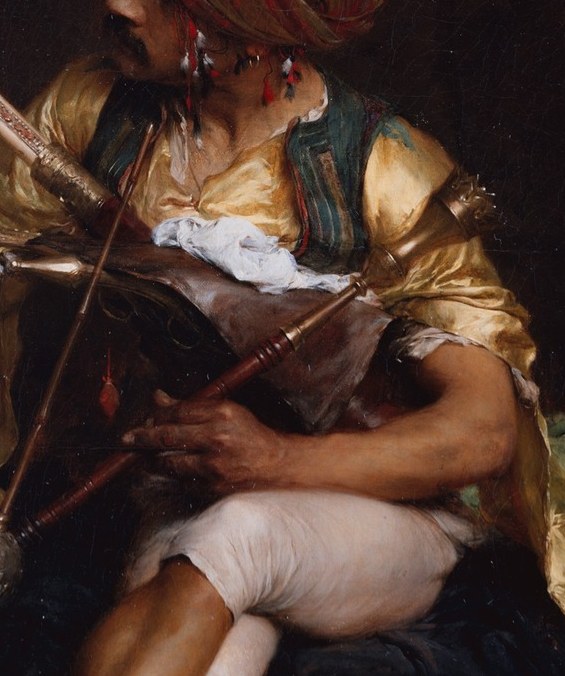
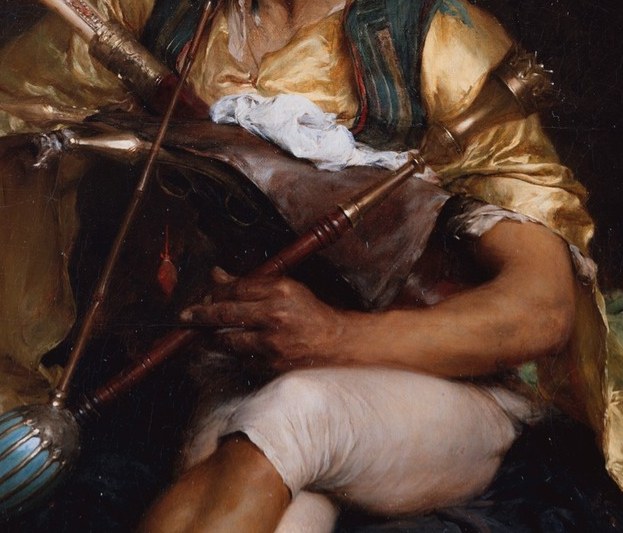
Look closely at the figure's attire: the vibrant red and yellow turban, the shimmering yellow robe, and the green embroidered vest. These details were intentionally chosen to evoke a sense of the 'exotic' and transport the viewer to another world.
Bargue, a Parisian artist celebrated for his influential drawing course, used dramatic contrasts of light and shadow, known as chiaroscuro, to give the figure depth and volume. While beautiful, these depictions were often romanticized and filtered through a European perspective, shaping how these cultures were perceived.
What do you notice first about his contemplative pose?
Details
Transcript
This man's clothing was designed to transport the viewer. His vibrant turban, robe, and vest suggest an 'exotic' world. This painting is a prime example of 19th-century Orientalism. Artists created dramatic scenes and figures from North Africa and the Middle East. He holds a long pipe, inviting contemplation or leisure. The strong light and shadow add depth to his introspective pose. But the scenes were often romanticized, viewed through a European lens.