Landscape with Shepherd by Robert S. Duncanson (American, 1821–1872)
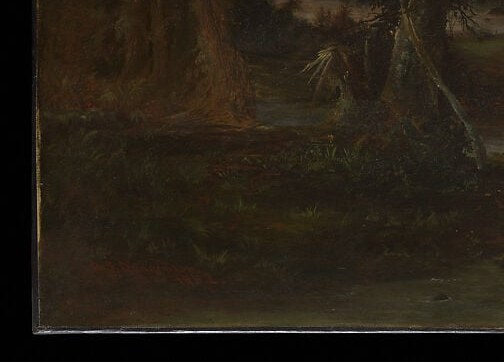
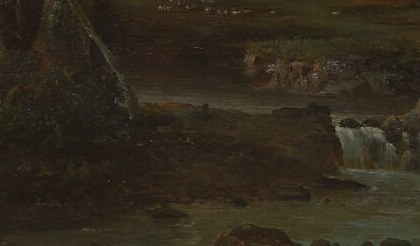
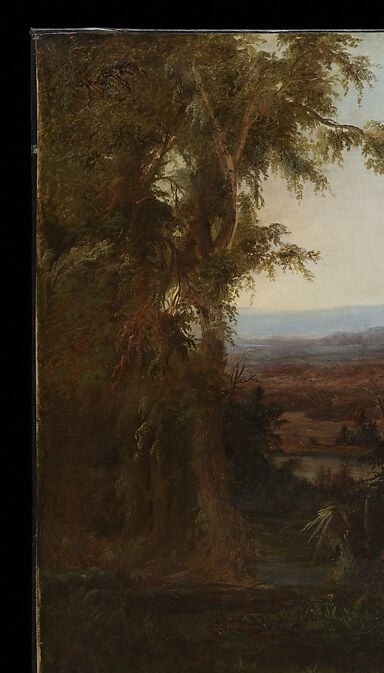
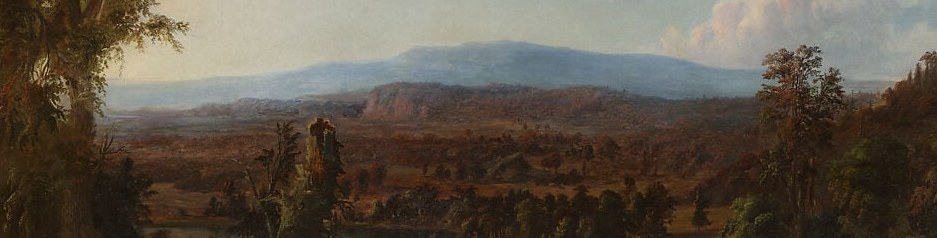
Robert S. Duncanson painted *Landscape with Shepherd* in 1852, while living in Cincinnati as a free Black man in the years before the Civil War. The painting now hangs in the Smithsonian American Art Museum. It is a classic Hudson River School vision, a luminous, idealized American valley, but the identity of the artist fills the peaceful scene with extraordinary quiet defiance.
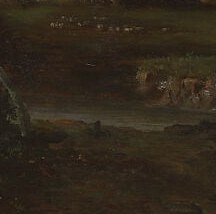
Look first at the tiny figure in red near the center. The shepherd stands alone, his flock scattered around him. The towering dark tree on the left frames him, and the sunlit valley glows beyond. Every element insists on harmony between the human figure and the vast land, a claim a Black man was not allowed to make lightly in 1852.
Duncanson was the grandson of freed slaves and taught himself to paint by copying engravings. He actively built relationships with abolitionist patrons in Ohio and England, and his talent eventually carried him to Europe. He became the first African American artist to achieve an international reputation. Some historians believe his landscapes contain coded references to the racial struggles of his time; others insist his work should be seen purely as an assertion of his mastery. Either way, standing in front of this painting, you are looking at a man claiming his place in the world.
There is no anger in the picture. Just a shepherd, his sheep, and a golden valley. That gentleness, coming from this artist at this moment, is its own kind of strength.
Details
Transcript
They called it the New Eden. A luminous valley, a promised land. But the painter was a free Black man in 1852. America was not yet his promised land. So he placed himself here. Barely visible. Still. A solitary man at peace with his flock. Duncanson would become the first internationally known African American artist.