The Hill of the Alhambra, Granada by Samuel Colman (American, 1832–1920)
The Hill of the Alhambra, Granada was painted in 1865 by the American artist Samuel Colman. By that point Colman was a respected member of the Hudson River School, a group of painters famous for luminous American landscapes. But he was also a restless traveller, and this sun-drenched view of a Spanish hillside let him bring a European vista back to an American audience.
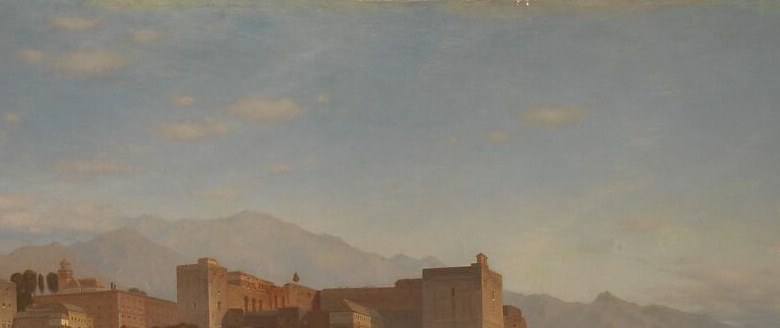
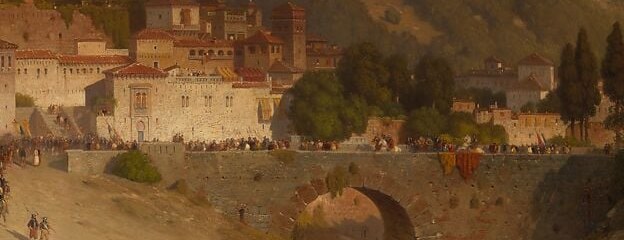
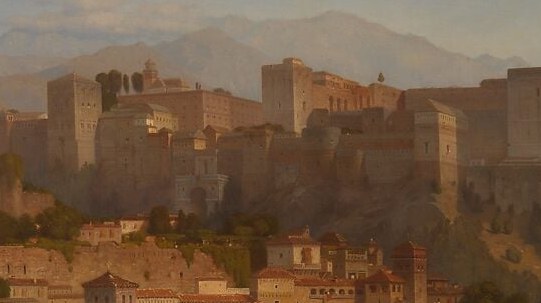
Look closely at the Alhambra itself. The paint on the fortress walls is remarkably thin, almost transparent. The canvas texture shows through, and the ochre tones seem to float in the haze. That effect was no accident. Colman deliberately thinned his oil paint with turpentine until it handled like watercolor, a trick his contemporaries considered unconventional for serious oil painting in the 1860s. The deep shadow under the stone bridge arch is one of the few places he laid on thicker pigment, and the contrast between that dense dark and the washed fortress is what makes the Alhambra glow.
Colman was not only a painter. He was also an interior designer, a collector of Asian art, and eventually a writer. His eye for decorative effect and atmosphere shows up everywhere in this canvas. The painting now belongs to the collection of the Metropolitan Museum of Art, a record of the moment an American landscapist turned his brush toward the Old World and found a way to make ancient stone feel like warm light on moving air.
The next time you see a painting where a distant building shimmers in the heat, ask yourself if the artist is showing you a place, or showing you the air itself.
Details


Transcript
Look at the light in the sky. A warm, golden haze that pools behind the mountains. An American painter, far from home, made this in 1865. He painted it in oil, not watercolor. Now look at the fortress itself. See how thin and washed the paint is? He used turpentine to make oil paint flow like water. That's how the distant Alhambra still shimmers in the heat.