New York Daily News by William Michael Harnett
William Michael Harnett painted *New York Daily News* in 1888, and the oil-on-wood panel now hangs in the Metropolitan Museum of Art. It is one of the tightest trompe-l'œil performances in American still life, a painting about painting's ability to deceive.
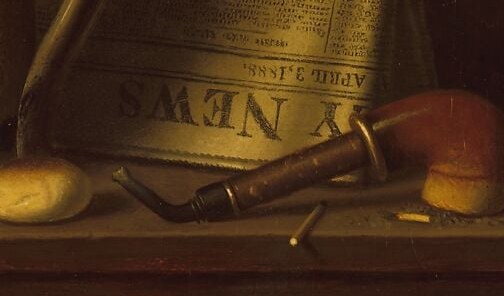
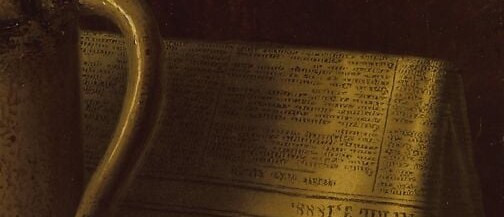
Look first at the newspaper. The masthead looks printed, but every letter was built by hand in oil. Then move to the crease: a smear of brown and white that reads as folded paper. Harnett was so good at this that accounts from the period describe people reaching out to touch the canvas, certain it was real newsprint pasted onto wood.
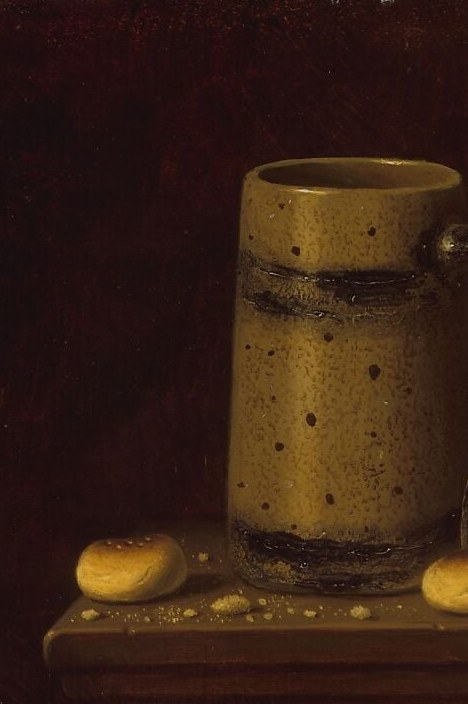
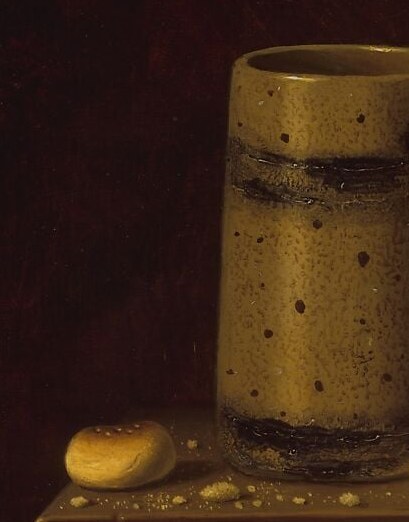
Now find the stein. Its body is covered in a salt-glaze speckle, a texture that Harnett rendered dot by individual dot. There is no shortcut in that surface. He just painted every tiny mark until the illusion of ceramic held. The rim is an ellipse so precise it forces your eye to accept a three-dimensional vessel on a two-dimensional plane.
Harnett died in 1892 at only forty-four, but his brief career left American realism with a measure of technical obsession it had rarely seen. The ordinary objects he chose, a daily paper, a pipe, a cracker, got the same microscopic attention a Dutch master gave to silver and lace. What everyday thing around you would deserve that kind of looking?
Details

Transcript
The first trick: a folded newspaper. That crease is just brown paint. Nothing more. A newspaper masthead, built letter by letter. Viewers reportedly leaned in to read the headlines. Second trick: a speckled stoneware stein. Each dot of the salt glaze was placed individually. Harnett spent hours on ceramic textures that most painters skip. Third trick: the wooden ledge pushes into your space.