鑑貞筆 瀟湘八景中の二景図|Two Views from the Eight Views of the Xiao and Xiang Rivers by Kantei
Kantei painted these two hanging scrolls around 1516, taking up a theme that had been travelling from China for centuries: the Eight Views of the Xiao and Xiang Rivers. The subject is a specific confluence in Hunan province, but by the time it reached Japanese ink painters it had become a shared visual language, a set of moods and weathers more than a place.
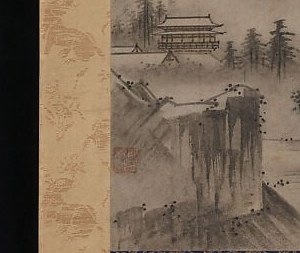
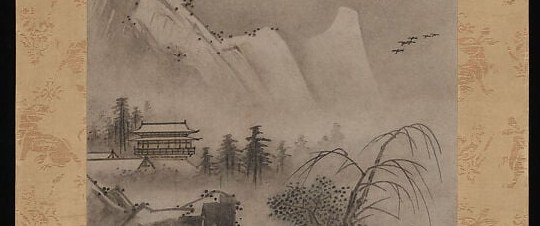
The first thing to watch is the foreground pines on the left scroll. They are near-black, laid down with a fully loaded brush while the paper was still damp. That deep wet-ink mass is what makes every pale tone behind it read as luminous. Run your eye to the cliff face: the strokes roughen into a dry brush dragged across the paper's tooth, leaving white gaps that read as sun-struck rock.
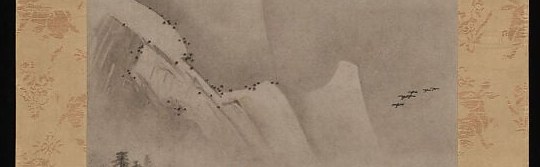
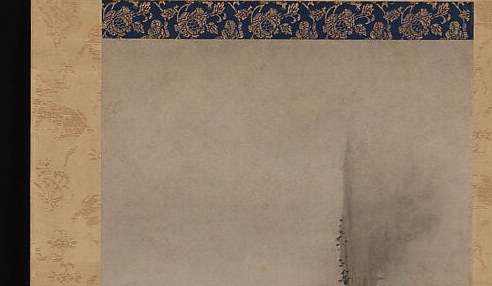
The real trick is the center. The broad band of mist and the river itself are untouched paper. No white pigment. No erasure. The painter simply stopped, and in stopping, created the most expressive zone in the entire composition. Above the water, faint horizontal washes graduate from barely-there grey into nothing at all; those are the layered mist bands, and they are what dissolve solid mountain into weather.
The scrolls are mounted with a dark brocade header characteristic of early Muromachi-era Japanese presentation. They would have been displayed as a pair, the river's expanse reading straight across, the blank paper carrying the scene's mood far more than any mark could. The painter's name, Kantei, survives; not much else about him does. But the thing he knew, that emptiness is not absence but the place where meaning gathers, is still perfectly legible, five centuries later.
Details
Transcript
First, look at the sheer tonnage of ink on the left. Wet black pines against the pale cliff. That contrast is the whole game. Now the center. The river, the mist, the depth, all of it is unpainted paper. There is no white pigment anywhere on this scroll. Those layered mist bands? Just progressively thinner ink washes. The distant mountains nearly vanish, ink diluted to the edge of water. Sixteenth-century Japanese painters called this 'the void where the meaning gathers.'