清 石濤(朱若極)、張子為 忍菴居士像 卷|Portrait of Ren'an in a Landscape by Shitao (Zhu Ruoji)|Zhang Ziwei
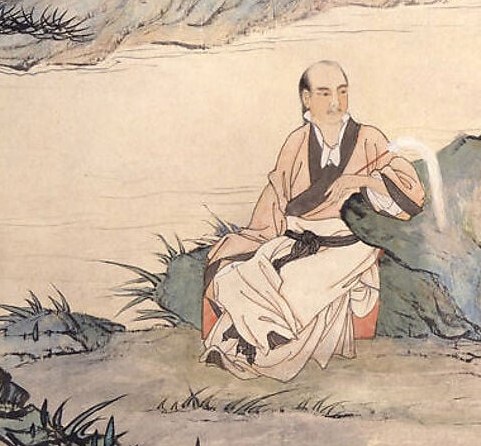
This is "Portrait of Ren'an in a Landscape," a 1684 handscroll by Shitao and Zhang Ziwei, now in the collection of the Metropolitan Museum of Art. It is a rare collaborative portrait: two artists, two distinct sets of hands, working on the same sheet of paper.
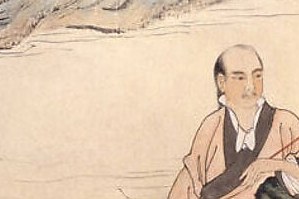
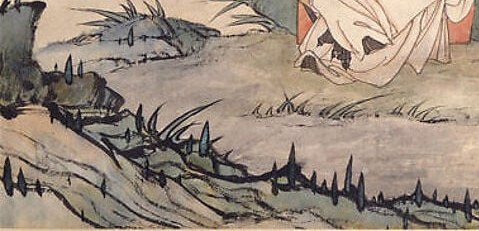
The first thing you notice is the seated scholar, Ren'an, draped in flowing white robes. His face is a specific, individual likeness, unusual in Chinese landscape painting, where figures are often generic. His hands rest still in his lap, the hands of a thinker rather than a laborer. Shitao built the landscape around him: the gnarled pine symbolizing integrity, the misty mountains dissolving into unpainted paper.
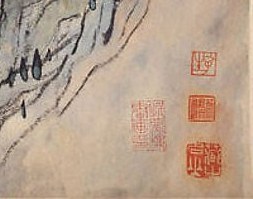
The real story, however, lives in the lower right corner. Those small vermilion squares are seal chops, stamped into the paper by successive owners across centuries. In the Chinese tradition, pressing your seal onto a work you treasured was an act of respect, and each one left a traceable mark of custody. Read together, the seals form a chain of provenance from the Qing dynasty to the present day.
A painting like this is never finished. It accumulates history with every stamp. The next time you see red seals on a Chinese scroll, look closely, you are seeing the signatures of everyone who held it before you.
Details

Transcript
A scholar rests on a rock, lost in thought. He was painted in 1684 by two different artists. One painted the landscape. The other painted the man. Now look at the lower right corner. These vermilion stamps are seals. Each one was pressed here by a collector who once owned this scroll. Together they map a provenance stretching across centuries.