Madonna and Child with Angels and Saints by Filippo Lippi
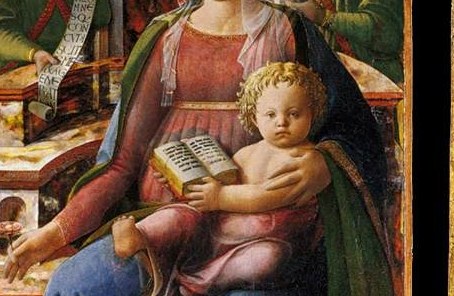
This striking work, Filippo Lippi’s “Madonna and Child with Angels and Saints,” was originally painted as a single triptych around 1440, but its history is as fragmented as its composition once was. For nearly two centuries, its three panels were separated, held in different collections across Europe.
The central panel, featuring the serene Madonna and Child, is now housed at the Metropolitan Museum of Art in New York. The two flanking panels, depicting Saints Augustine, Ambrose, Gregory, and Jerome, reside in the Accademia Albertina in Turin. These distinct sections, each a masterpiece in its own right, were created to be seen as one cohesive narrative.
The triptych was likely disassembled in the late 18th century, only to be dramatically reunited for the “Exposition de l'art italien de Cimabue à Tiepolo” in Paris in 1935, and again in Turin in 2004. This reunion allowed audiences to finally appreciate Lippi's original vision, showcasing his mastery of tempera and the intimate religious narrative.
It's a powerful reminder of how the journey of art can sometimes be as compelling as the art itself. Can you imagine the surprise of seeing these pieces together after so long?
Details
Transcript
This painting is actually three separate panels. It was painted as a triptych around 1440 by Filippo Lippi. The two side panels depict four important saints. But the triptych was split apart in the 18th century. For almost two centuries, its pieces were in different collections. They were finally reunited for an exhibition in 1935.