Sunset by Harvey O. Young
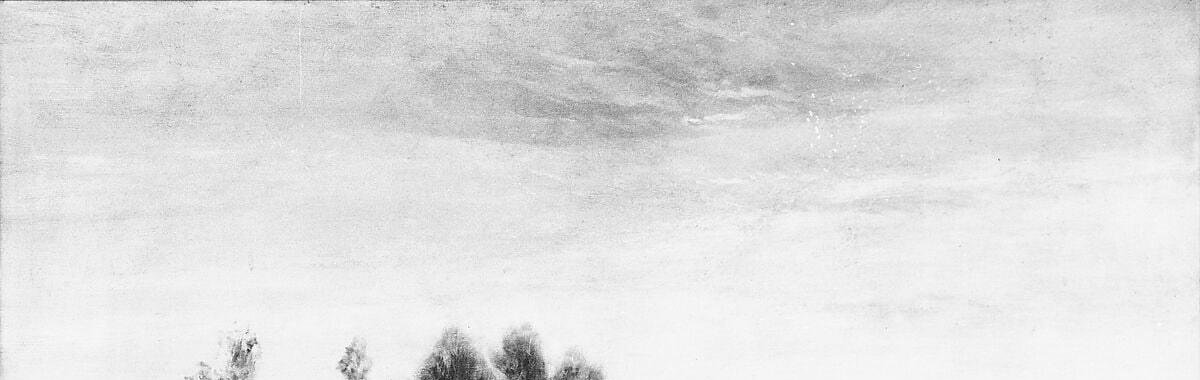
Harvey O. Young's "Sunset" (ca. 1875) is a quiet American Impressionist landscape that builds its whole atmosphere from a single horizontal band of near-white paint.
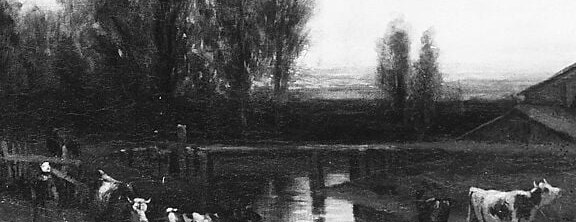
The painting's real trick lives just above the horizon, where the dusk sky lightens to a pale luminous strip. Young uses that band as a light source: it silhouettes the cattle and the feathery trees against the sky. The pond below mirrors the same pale tone, pulling the glow downward so the whole landscape feels steeped in evening light.
Young was a prospector who helped found the Artists' Club of Denver, the group that evolved into the Denver Art Museum. While other painters were heading to the Rockies for monumental views, Young stayed in the plains and found his drama in the way light settles across a working farm at dusk. The low horizon, the loose handling in the foreground grass, and the softening of the distant tree line all show a painter thinking hard about atmosphere.
Next time you see a sunset painting, look for the specific band of light that's actually carrying the effect. Once you spot it, the rest of the picture falls into place.
Details



Transcript
A Colorado prospector painted this quiet dusk scene. Harvey O. Young co-founded what became the Denver Art Museum. Now focus on the lowest third of the sky. A single pale band bleaches toward white. That band is doing all the work of the sunset. The pond picks it up and pulls the light down into the land. Against that glow, every tree and cow reads as a silhouette.