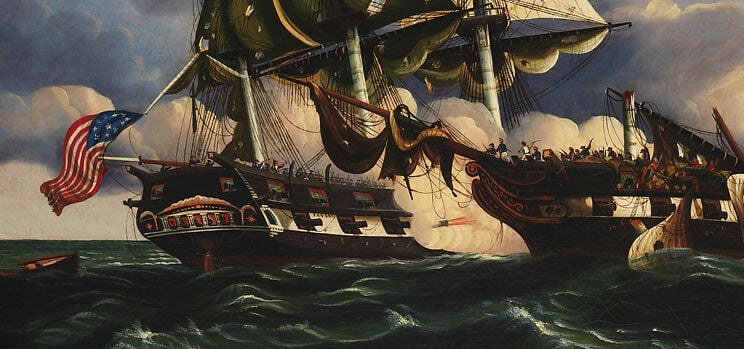
The Constitution and the Guerriere by Thomas Chambers
View the artwork: The Constitution and the Guerriere →
This is Thomas Chambers' The Constitution and the Guerriere, painted around 1845. Chambers was born in Whitby, England, in 1808, the brother of a celebrated marine painter, but he never trained formally. He learned by watching his brother, then sailed for America in 1832 to become an itinerant artist, listing himself as a marine and landscape painter in New York, Boston, and Baltimore.
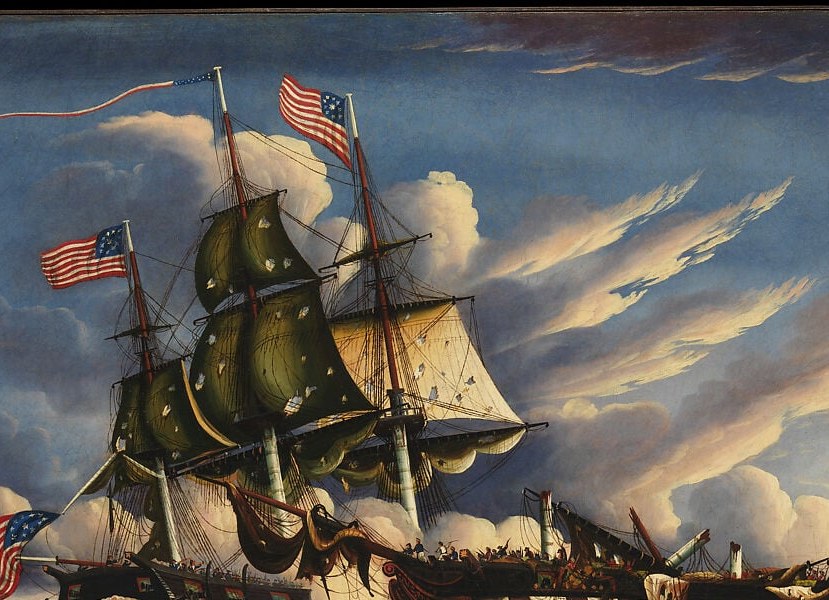
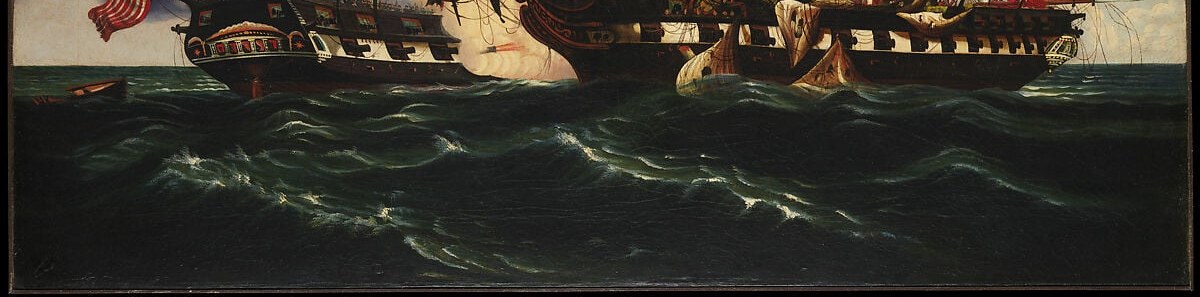
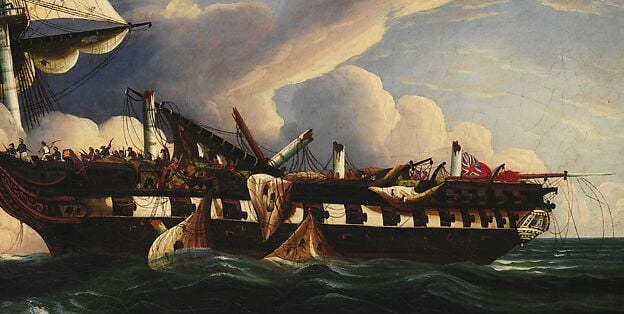
What you are seeing is a memory of a battle Chambers never witnessed. He reconstructed this scene from newspaper sketches and popular prints, which is why the waves feel more decorative than documentary, the smoke more theatrical than accurate. The British frigate Guerriere is barely visible in the right background, already half-lost. The USS Constitution fills the frame, white sails luminous, hull dark and formidable.
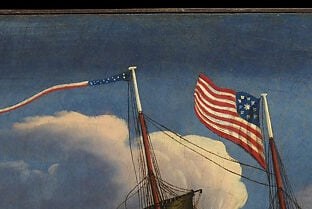
The real battle happened on August 19, 1812. The Constitution earned the nickname Old Ironsides when sailors watched British shot bounce off her live-oak hull. Chambers painted this decades later, at a moment when America was still defining its national story. The flags do a lot of the work here: one at the masthead, one on the bowsprit, both planted against a dramatic sky.
Chambers died in a Whitby poorhouse in 1869, his name largely forgotten. Collectors only identified this painting as his in 1942, when they matched it to a signed canvas. He never signed most of his work. He just painted.
#arthistory #navalart #americanart
Details
Transcript
They called her Old Ironsides. British cannonballs bounced off her thick oak hull. This is how a man who never saw the ocean fight remembered it. He built every wave and cloud from newspaper sketches. The British ship is already half-swallowed by smoke. And the American flag flies from the highest point in the composition. Thomas Chambers painted this for a young nation that needed heroes.