Madonna and Child with Saint John the Baptist, Saint Peter, and Two Angels by Tuscan 13th Century
View the artwork: Madonna and Child with Saint John the Baptist, Saint Peter, and Two Angels →
This small devotional panel spent more than a century burdened by a name that wasn't its own. The Pisan collector Carlo Lasinio acquired it from the Church of San Francesco in the early 1800s and attributed it to Cimabue, the celebrated master who stood at the threshold of the Italian Renaissance. The attribution stuck, bringing the work attention it might never have received and a status it could never quite live up to.
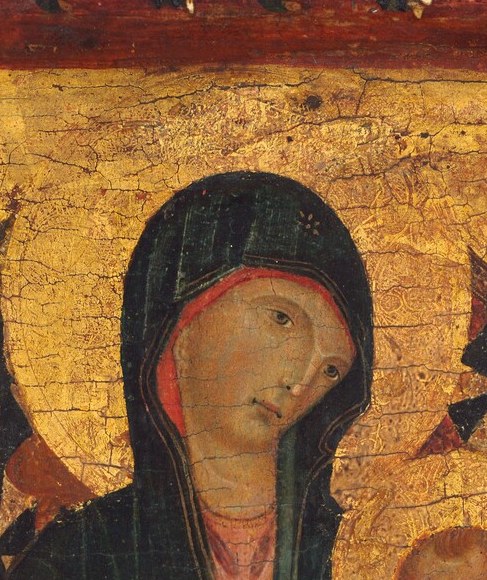
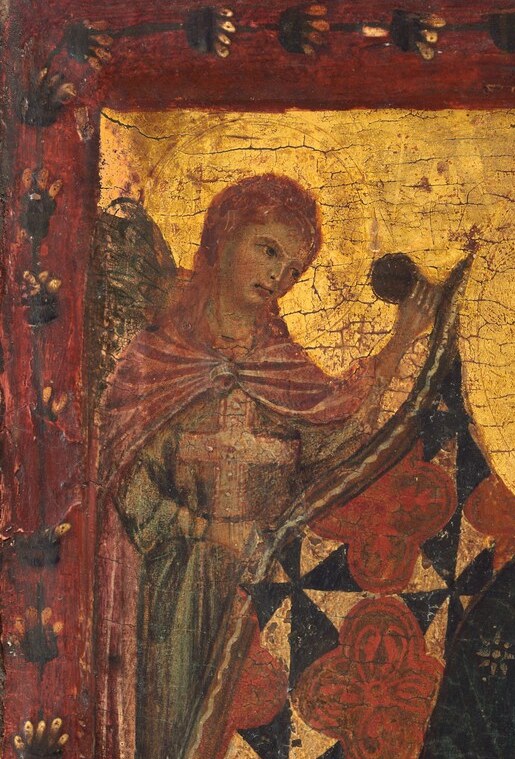
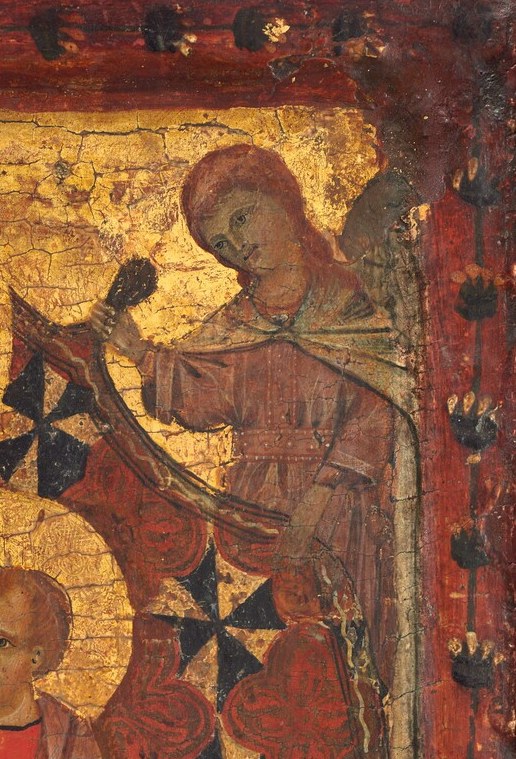
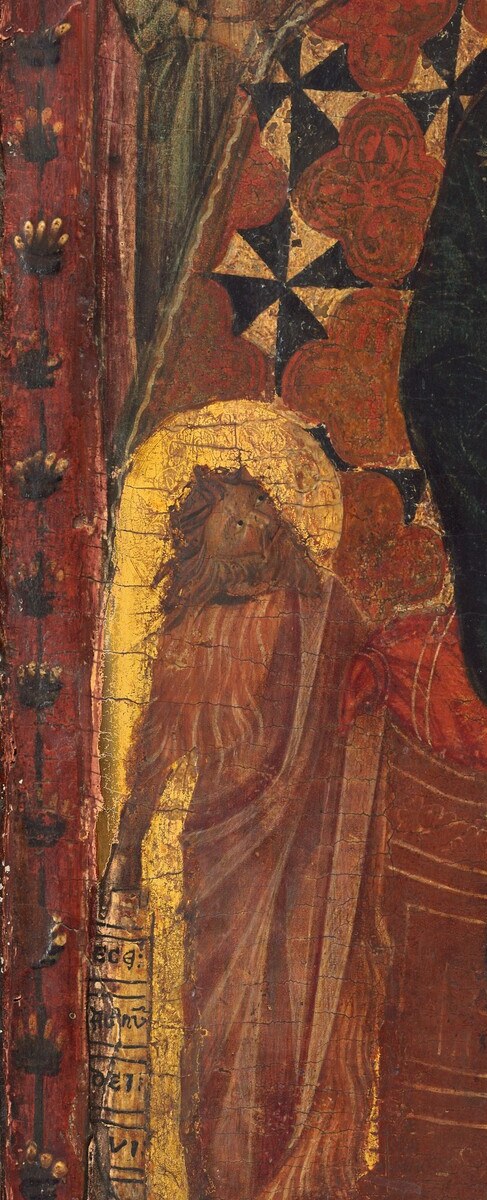
Once you look past the gold ground and the hieratic faces, the painting tells a quieter truth. The frame, carved from the same poplar plank as the panel itself, was never gilded. It was painted red and decorated with a frieze of daisies, a symbol of the Incarnation. The throne behind the Virgin has no backrest; its base is simplified, almost an afterthought. These are not the choices of a commission from a wealthy cathedral or a demanding abbot. They speak of a patron with limited means and a workshop that worked fast.
X-radiographs reveal possible former hinges, suggesting this panel may once have formed the center of a portable triptych, a personal object made for private devotion and travel. Its documented provenance is a zigzag through the art market: from Pisa to the collection of Francis Douce, then a Mrs. Fanshaw, a country sale in England in 1934, the London dealer Colnaghi, the Florentine Alessandro Contini-Bonacossi, and finally the Samuel H. Kress Foundation, which gave it to the National Gallery of Art in Washington, D.C., in 1952.
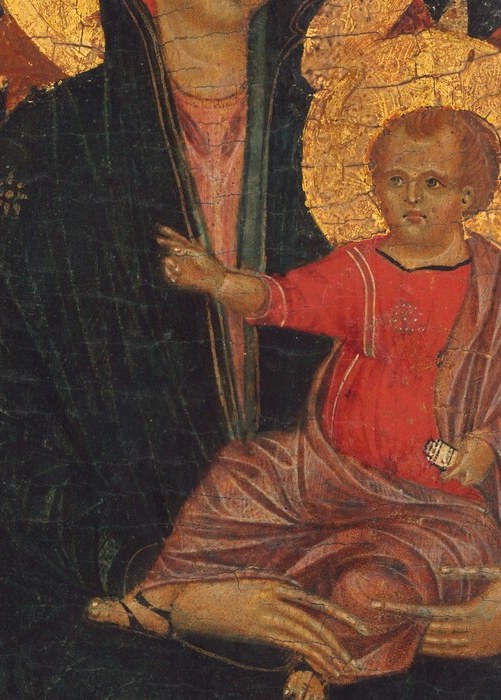
Most scholars have since set aside the Cimabue attribution and now classify the work simply as 'Tuscan 13th Century.' What remains is an object of genuine intimacy. The anonymous painter took the greatest care not with the throne or the frame, but with the theology: the three-fingered blessing hand of Christ and the legible scroll of Saint John the Baptist carry the weight of the image.
#arthistory #13thcentury #italianart
Details
Transcript
For over a century, this panel was called a Cimabue. A name that gave it stature. And a problem it didn't deserve. The name was wishful thinking from an 1800s collector. The frame was never gilded. Just painted red, with daisies. A patron of modest means. A workshop with no time to waste. The throne's backrest is missing. A corner was cut. Later scholars stripped the famous name away. Now it's just 'Tuscan, 13th Century.' But the blessing hand and the scroll were painted with absolute care.