Artwork
Madonna and Child with Saint John the Baptist, Saint Peter, and Two Angels
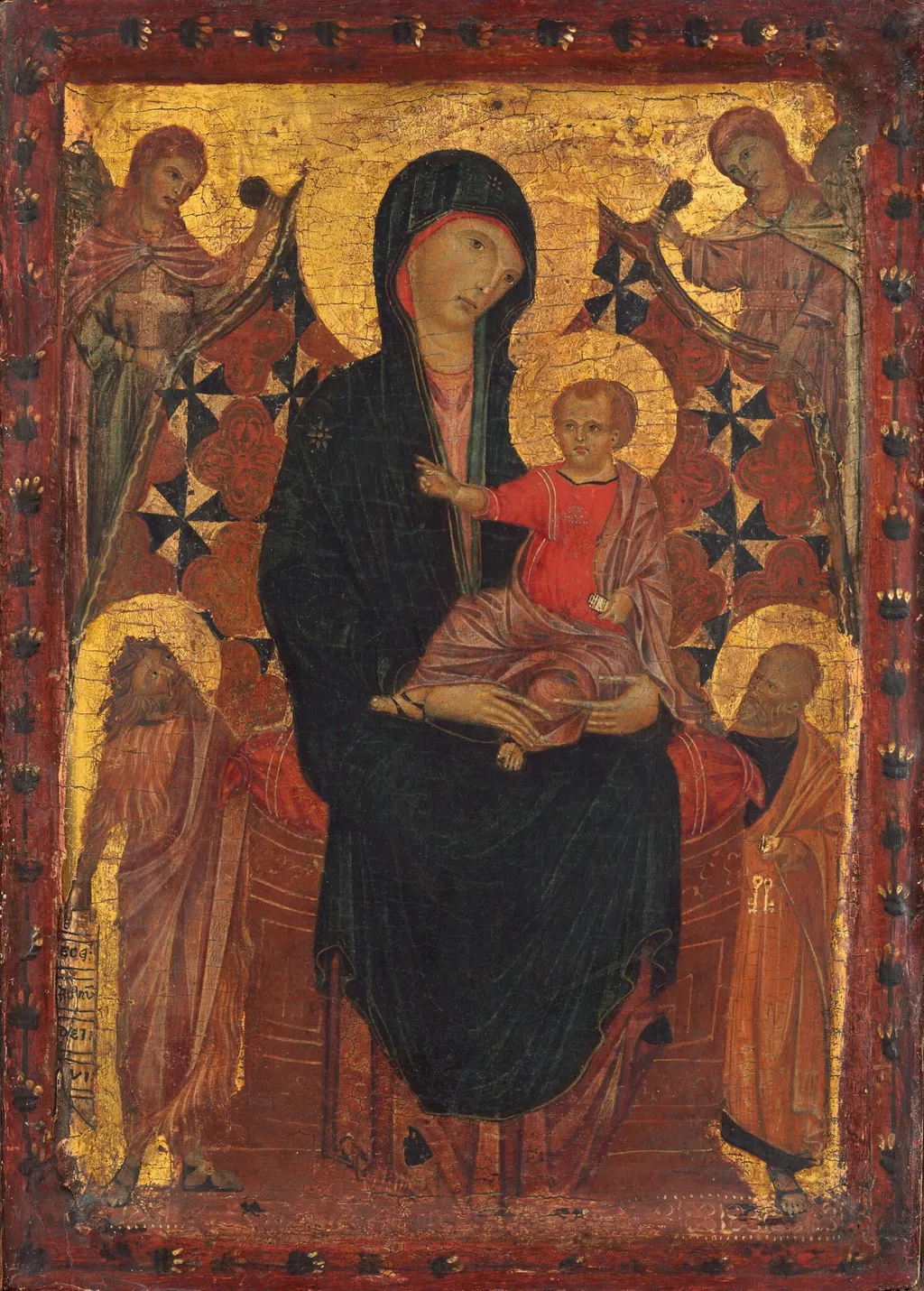
Madonna and Child with Saint John the Baptist, Saint Peter, and Two Angels is a tempera painting. It dates from 1290 and is held in the collection of the National Gallery of Art.
- Inscription
- Inscribed:on the scroll held by Saint John the Baptist: E[C]CE / AGNU[S] / DEI:[ECCE] / [Q]UI [TOLLIT PECCATUM MUNDI] (from John 1:29)
About this work
Subject & Meaning
The cloth features white eight-pointed crosses on a black field, alluding to the symbol of the Order of Malta, which had a base in Pisa.
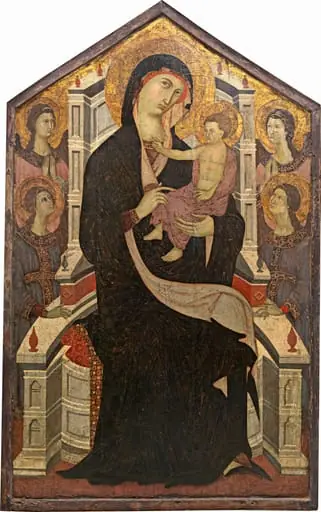
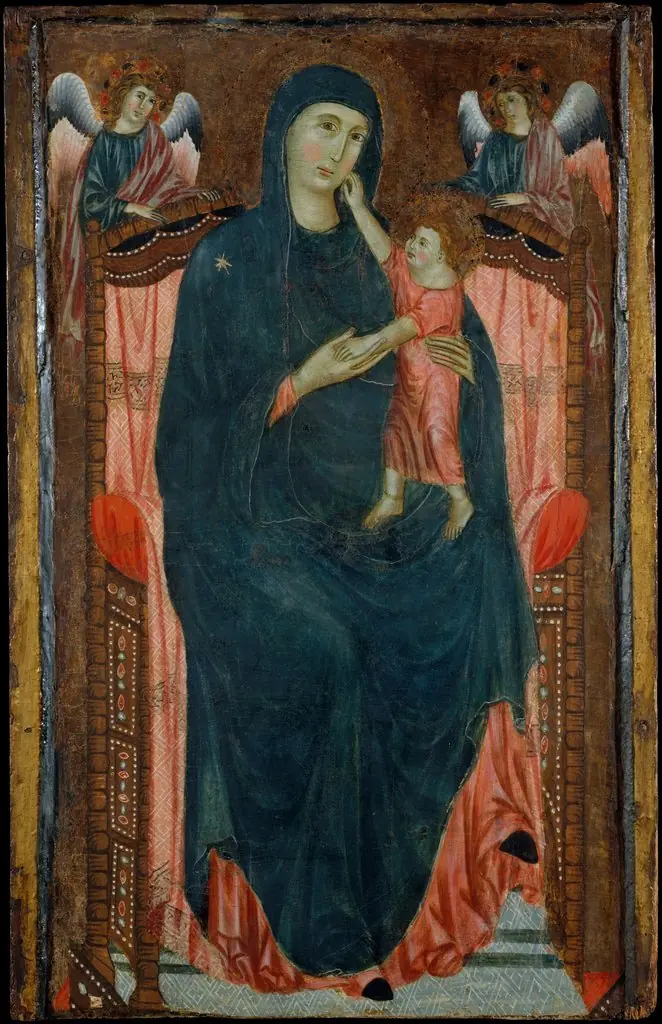
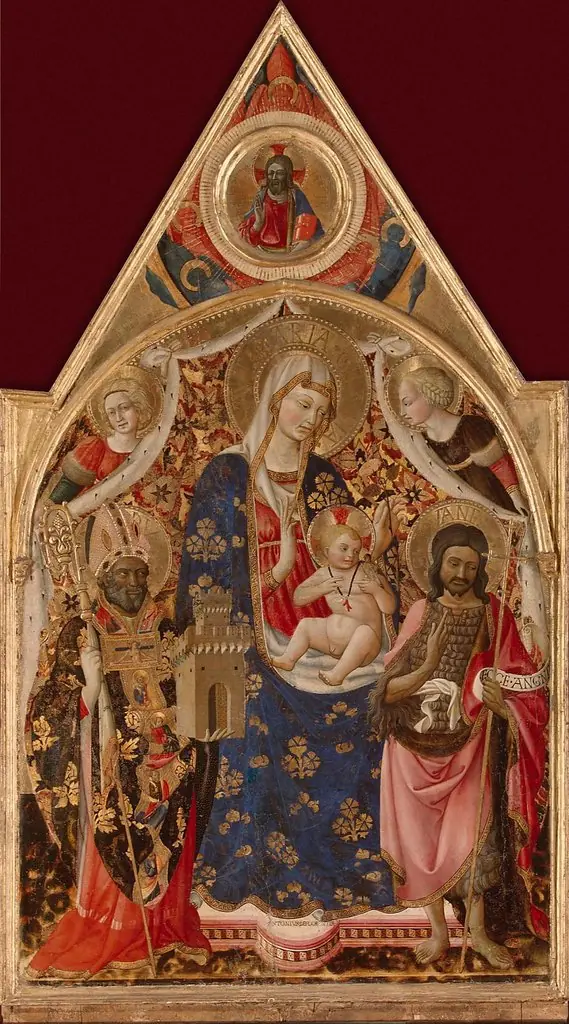
The painting depicts the Virgin Mary enthroned with the Christ Child, flanked by two angels and the saints John the Baptist and Peter. Mary sits on a high throne with a red cushion, while two angels, likely Archangels Gabriel and Michael (Michael identified by a white cross on his chest), hold an ornate cloth behind her. The cloth features white eight-pointed crosses on a black field, alluding to the symbol of the Order of Malta, which had a base in Pisa.
Below, John the Baptist bears a scroll with the opening words “Ecce Agnus Dei,” and Peter holds golden keys. John was the patron saint of the Order of Malta, and Peter represents the Pope, the Order’s spiritual head. This iconography suggests the panel was commissioned for the devotion of the Pisan Knights of Malta. The Christ Child blesses toward John, reinforcing the reference to Christ as the Lamb of God.
Technique & Style
Executed in tempera and gold on a small panel (approximately 34.3 x 24.4 cm), the painting exhibits a hierarchical, iconic composition typical of late-thirteenth-century Tuscan painting. The Madonna and Child are enthroned beneath a fan-shaped drape held by two angels, its textile pattern incorporating floral motifs and octagons with white crosses on a black field. The saints John the Baptist and Peter appear in the lower register.
The Child’s blessing gesture and lively crossed legs introduce a note of animation, while the pointed facial types and flat gold background reflect Byzantine conventions. The fine handling and miniaturist scale suggest a devotional panel possibly created for a private setting.
History & Provenance
The painting is documented as coming from the sacristy of the Church of San Francesco in Pisa, recorded by the collector Carlo Lasinio (1759–1838), who inscribed the panel with an attribution to Cimabue. It then passed through various private collections: possibly owned by Francis Douce by 1829, then by Mrs. Fanshaw, and offered at Christie & Manson in 1835. After a country sale at Patterdale Hall in 1934, it was acquired by the dealer P. & D. Colnaghi & Co. and sold in 1935 to Gualtiero Volterra.
By 1935 it was in the collection of Count Alessandro Contini-Bonaccossi in Florence, who sold it in 1948 to the Samuel H. Kress Foundation. The foundation donated it to the National Gallery of Art, Washington, in 1952. The work is generally dated to around 1280.
A possible commission context is suggested by the inclusion of Saint John the Baptist and Saint Peter, potentially linking it to the devotional needs of the Knights of Malta in Pisa.
The painting is held at the National Gallery of Art, Washington, D.C., in the Samuel H. Kress Collection. It was accessioned in 1952 as a gift from the Samuel H. Kress Foundation, which had purchased the work in 1948 from Count Alessandro Contini-Bonaccossi. Its earlier provenance includes private collections and sales in London and Patterdale Hall before being acquired by the foundation. The provided sources do not record a specific inventory number or any exhibition history.
Context
The attribution of the small panel has been a central issue in its scholarship. Although it once bore an inscription linking it to Cimabue, most modern scholarship has debated its autograph status. Supporters of Cimabue's hand include Longhi (1948), Suida (1956), and Bologna (1960), while Garrison (1949) and Brandi (1951) attributed it to a Florentine artist.
Samek Ludovici (1956) and Carli (1958) placed it within Cimabue's circle. Stylistic comparisons to the London Maestà and the Flagellation in New York reveal notable differences, suggesting the work may reflect a miniaturist approach due to its small scale. The panel's iconography, particularly the inclusion of Saint John the Baptist and Saint Peter, has been linked to the Knights of Malta in Pisa, situating the piece within the broader devotional context of the late Duecento.
Overview
This small devotional panel, executed in tempera around 1290, is attributed to an anonymous Tuscan artist working within the stylistic orbit of Cimabue. Barely larger than a sheet of paper, it depicts the Virgin Mary enthroned, presenting the Christ Child to the viewer. The painting's intimate scale and subject matter suggest it was intended for private contemplation.
Artist & collection