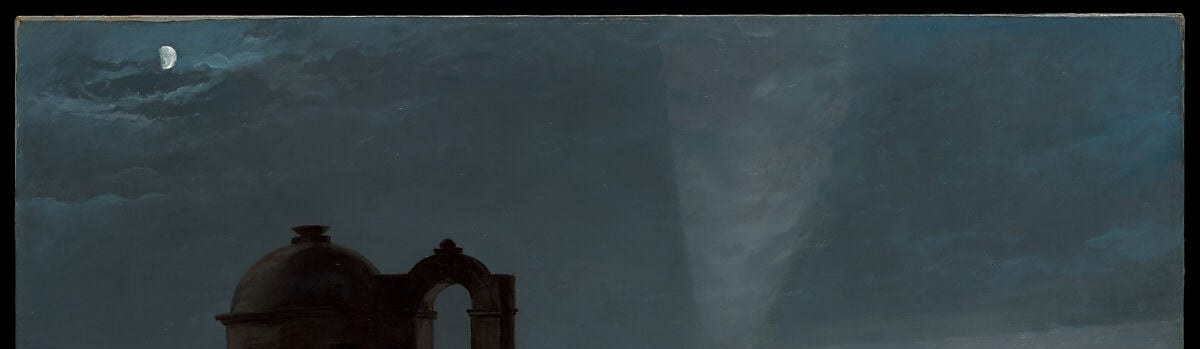
Searchlight on Harbor Entrance, Santiago de Cuba by Winslow Homer (American, 1836–1910)
Winslow Homer painted "Searchlight on Harbor Entrance, Santiago de Cuba" in 1902, but his sketches for it date to 1895, three years before the battle that made this fortress famous. The painting is in the Metropolitan Museum of Art, Gallery 767.
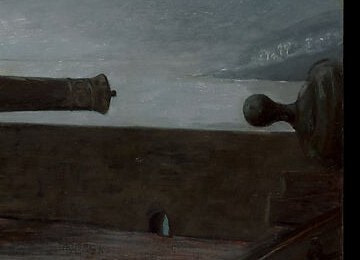
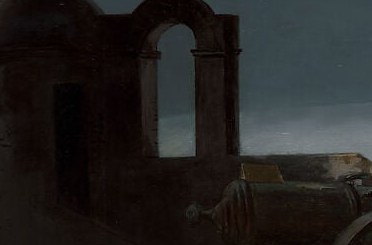
The subject is Castillo de San Pedro de la Roca, called Morro Castle, a Spanish colonial fortress guarding the harbor at Santiago de Cuba. Homer gives us a nocturne built around a single modern element: an electric searchlight sweeping the black water. Ancient stone, heavy muzzle-loading cannon, and a beam of electric light, 1898 arriving at a 1638 fortress.
The painting exists because of a court of inquiry. In 1901, the U.S. Navy convened one to settle a public argument over who deserved credit for destroying the Spanish fleet at Santiago. The hearings dragged the battle back into the newspapers. Homer, who had been there sketching in peacetime, returned to his watercolors and produced this dark, deliberate canvas during the renewed attention.
Look at the searchlight glow catching the rough masonry of the old fortification wall. Homer was in his sixties, a master of marine painting, and that single warm passage across cold stone is the quietest, most controlled moment in the picture. A man-made light exposing a man-made war.
Details


Transcript
Two cannons point at a dark harbor mouth. This fortress guarded Santiago de Cuba for Spain since 1638. But the painting is not really about the cannons. In 1898, the U.S. Navy trapped a Spanish fleet inside this harbor. When the fleet tried to run, American guns destroyed it. Three years later, a court of inquiry fought over which American commander deserved credit. Homer painted this in 1902 from sketches made on site before the battle.