三樹坡曉色图|View of the Kamo River from Sanbogi at Dawn by Oda Kaisen
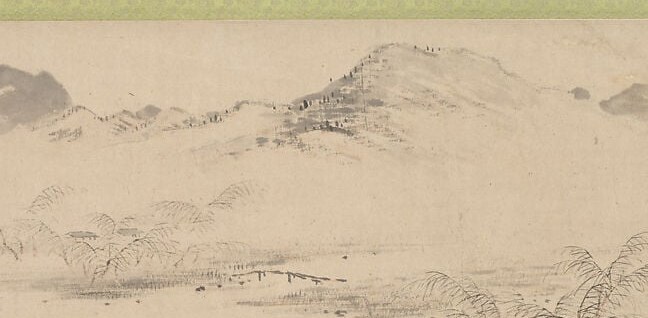
View of the Kamo River from Sanbogi at Dawn (1829) by Oda Kaisen is a hanging scroll built from absence as much as presence. The paper itself is the river, the mist, the glowing air between the hills. Ink washes darken into land and then fade back into atmosphere, using a technique called "negative space" that makes the scene feel luminous rather than described.
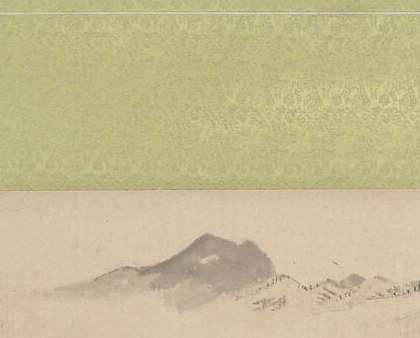
What to look for: start at the center where the unpainted paper opens into the Kamo River. Barely visible dark flecks in that misty zone are boats or riverside structures, the only hint of Kyoto's human life. Then scan to the far left edge, where a mountain passage is diluted almost to invisibility. That deliberate near-erasure pushes the panorama's depth to its absolute limit, and it is easy to miss entirely.
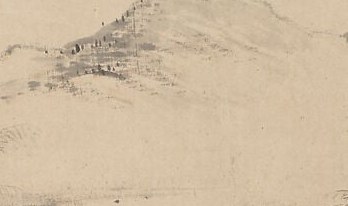
Kaisen made this when most Japanese painters were still strictly copying Chinese landscape models. Choosing to depict a specific, recognizable bend of the Kamo River at a datable moment, the colophon records the exact location, year, and time of day, was a quiet departure. The varied brushwork on the mountain face to the left shows him working from observation of actual Kyoto topography, not studio formulas.
The two red artist seals beneath the inscription are the only saturated color in a near-monochrome scene: at once a signature, a visual punctuation mark, and an authentication device, planted in a world dissolving into mist.
Details
Transcript
Almost the entire painting is empty paper. The river and mist are not painted. They are the raw scroll. The faintest marks show Kyoto's riverbank waking up. Now look at the far left edge of the world. That mountain exists at the very limit of what ink can do. Kaisen broke with Chinese convention to paint a real Kyoto dawn. The colophon pins the moment: Sanbogi, 1829, at first light.