Funeral Procession, Tomb of Pairy by Nina M. Davies
This is *Funeral Procession, Tomb of Pairy*, a painted copy of an ancient Egyptian tomb scene made by Egyptologist and illustrator Nina M. Davies around the early twentieth century. The original tomb painting dates to roughly 1396 BCE and is preserved through Davies' meticulous work, now in the collection of The Metropolitan Museum of Art.
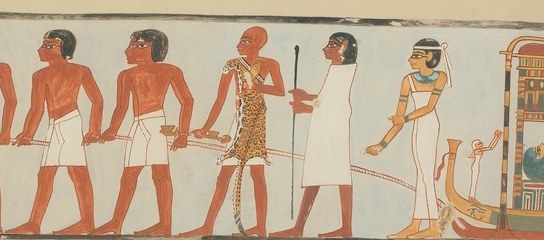
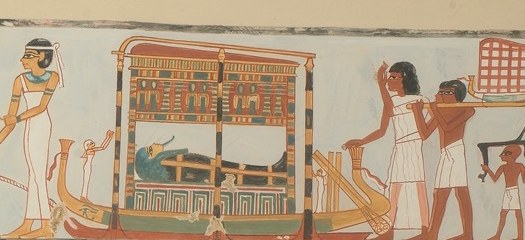
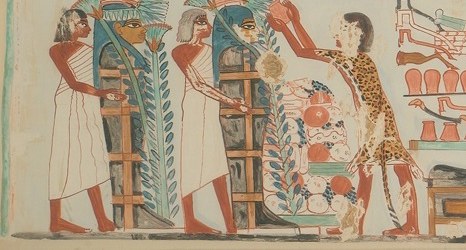
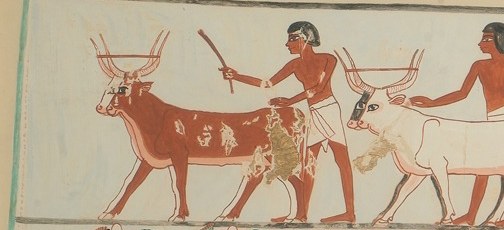
Davies copied a rigid, two-register composition. In the upper band, oxen drag a funeral sledge bearing the mummy case while a golden portable shrine and lines of priests and officials follow. The lower register shows a column of offering-bearers and, on the left, a group of female professional mourners.
Those mourners carry the emotional weight. Their arms are thrown upward, hands held to their heads in a formal gesture of lament that ancient Egyptian art codified and repeated for centuries. It is a pose stripped of subtlety: pure, public grief, frozen in ochre and linen.
Nina M. Davies and her husband Norman de Garis Davies spent decades copying tomb paintings in Egypt, often publishing jointly. Their copies, made before time and tourism could do more damage, are now primary records. This scene, with its stark red cattle and rigid profiles, is a record not just of a funeral but of how a civilization made loss visible.
Details

Transcript
A funeral. Ancient Egypt. The body travels by sledge, pulled by cattle. Priests carry a golden shrine. A portable sacred space. But look below the dividing line. Professional mourners, arms lifted in lament. This raised-arm gesture of grief still reads instantly today.