The Death of the First Born by Erastus Salisbury Field
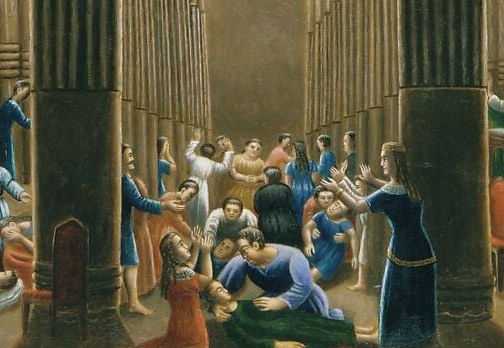
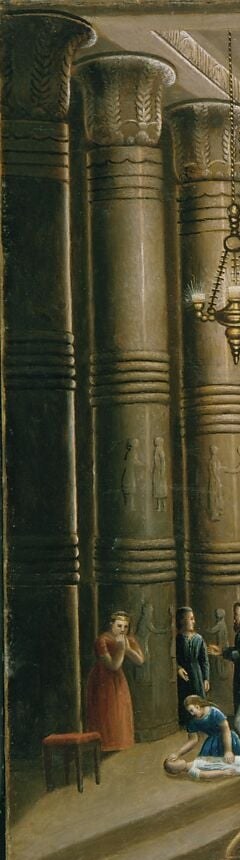
This is The Death of the First Born, painted in 1872 by Erastus Salisbury Field, a self-taught American folk artist. It hangs today in anonymity relative to its ambition, fame rank 3,947 out of roughly 241,000 artists, yet the painting contains one of the most audacious architectural illusions in 19th-century folk art. Field built an Egyptian palatial hall that appears to plunge a hundred feet deep, lit by a single governing light source. He had about three months of formal instruction, under Samuel F. B. Morse, before Morse closed his studio and Field went home to Massachusetts to become an itinerant portraitist. This canvas represents the tenth plague of Exodus, but the real trick is the space itself.
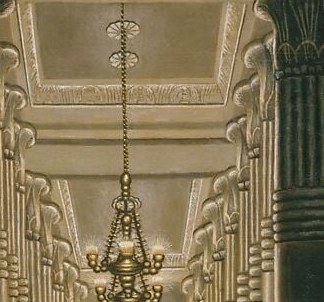
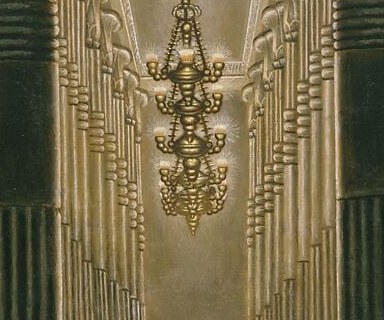
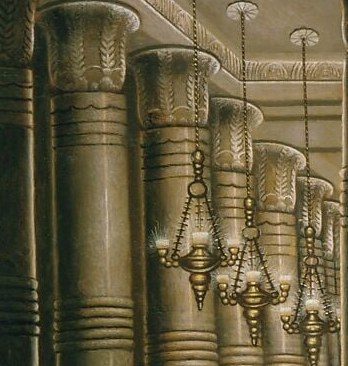
Watch the central chandelier. It is the luminance anchor: the warmest, brightest note in the composition, and Field uses it like a stagehand uses a follow spot. It pulls your eye straight down the axis to the small still body at center floor, then releases you into the colonnade. The repeating hanging lamps along the left and right walls do the real architectural work, each one slightly smaller, slightly dimmer, creating a rhythm that convinces your eye the hall recedes. Field learned this by looking, not in a classroom.
Born in 1805, Field made his living as a limner, traveling the Connecticut Valley, painting portraits for families who wanted a good likeness in one sitting. He was known for exactly that efficiency. By the 1840s he had settled briefly in New York, likely working with photography, and by the 1860s and 70s he was constructing these wildly ambitious history paintings. The Egyptian motifs in this canvas reflect the 19th-century Egyptomania that swept America, but Field had no access to archaeological drawings, the columns are folk-art inventions, the right pair differing subtly from the left. That inconsistency is the signature: a lone painter solving problems with what he had.
The pale light at the colonnade's vanishing point is the koan of the painting. It is barely a window, just a luminous arch that reads as something outside the natural. Field gave the Angel of Death no body; he gave it a brightness beyond the columns. A self-taught painter made a theological argument entirely through value and perspective. Next time you see a vast Hollywood set, consider the Massachusetts portraitist who got there first with a brush and an improvised rule.
Details
Transcript
It begins with a glow. The chandelier pulls your eye down into the story. Erastus Salisbury Field had only a few months of formal training. Yet he builds a colonnade that recedes over a hundred feet into the dark. Look at the vanishing point, a tiny arch of pale light. He painted that single distant glow to read as something otherworldly. Now look left, the hanging lamps repeat, shrinking, each one an anchor for the illusion. Field did this in 1872, far from any academy, with a brush and a rule he improvised.