The Last Throw by Charles Robert Leslie
This is The Last Throw, a genre scene painted around 1840 by the British-born artist Charles Robert Leslie.
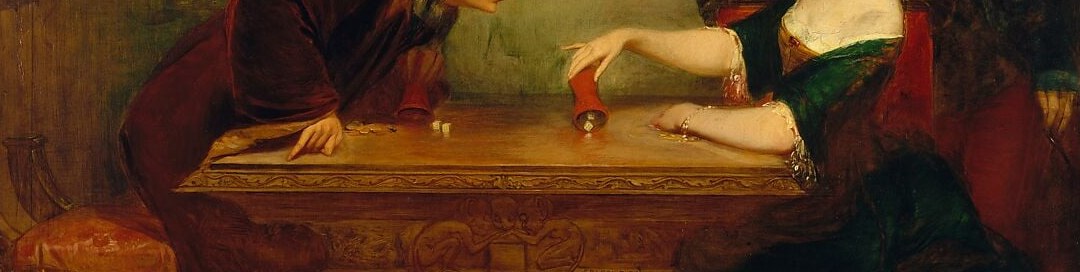
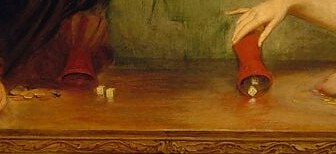
It looks like a simple gambling picture at first, but Leslie built it as a moral decoder. The backgammon board is not just a prop: its visible points mark the state of play, telling you exactly who is winning before the dice even fall. The game itself was understood in the 19th century as a test of character, where chance reveals the soul.
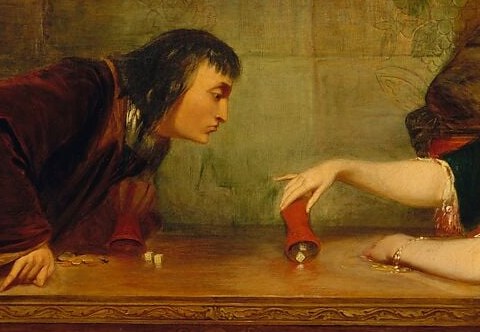
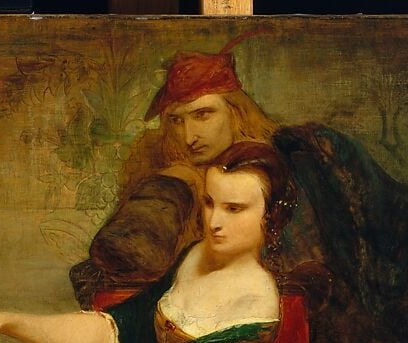
At the center is a woman in a striking teal-green dress. In a room painted entirely in warm browns and deep shadow, that cool green marks her as the moral center of the scene. Her face holds an ambiguity Leslie was known for: calm and tension held in the same moment. Flanking her are men whose bodies collapse forward with desperate intensity. The figure in the red hat behind her is crucial: he is not playing. He is a witness. A creditor, perhaps, or a companion to the ruin unfolding.
Charles Robert Leslie spent his career painting everyday people and the psychological weight of ordinary moments. The Last Throw freezes the instant just before the dice settle, when every figure in the room already knows what is at stake and we are left to read it in their bodies.
Details
Transcript
A game. But look at what else is here. A backgammon board. Its points map who is winning. Backgammon was considered a moral test in the 1840s. The dice are the pivot. The last throw. She wears cool green in a warm, dark room. The moral center. Her face: tension and control in the same instant. That man in the red hat is not a player. He is a witness. Charles Robert Leslie paints the moment fate is no longer your own.