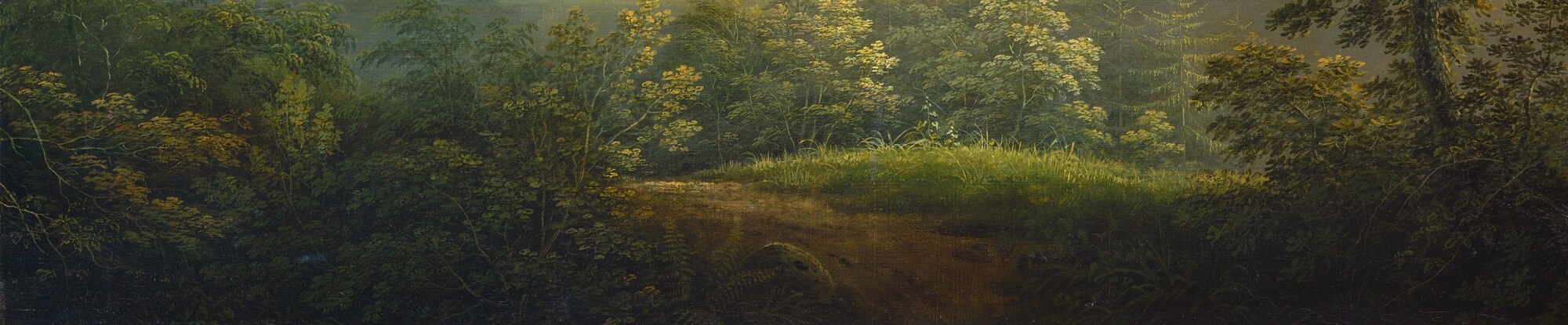
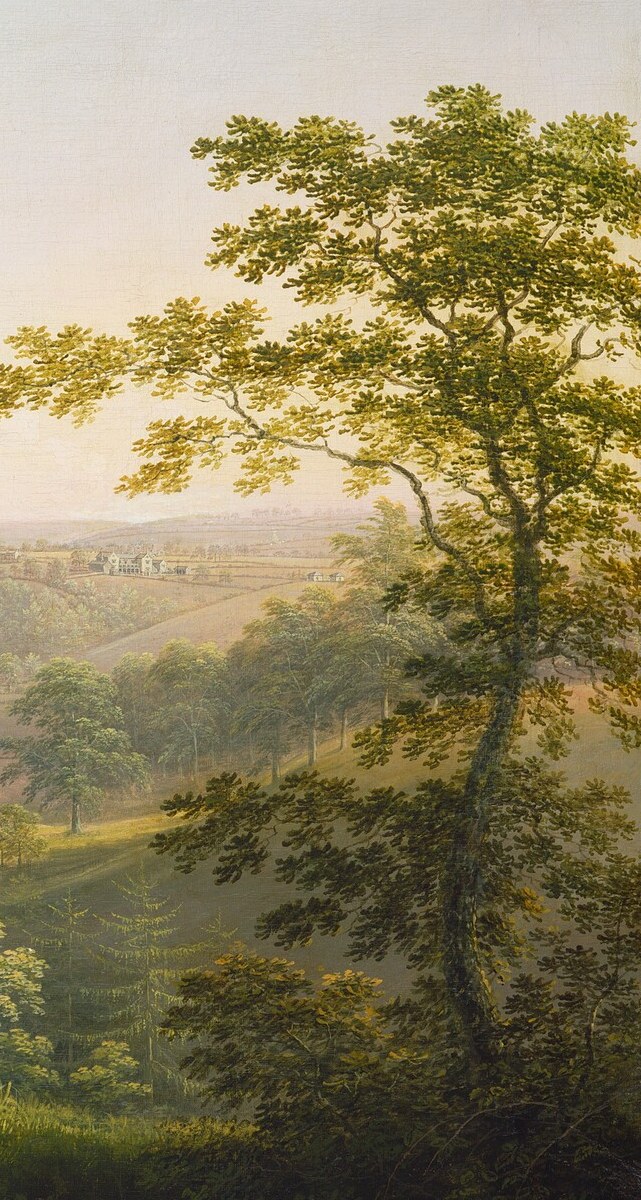
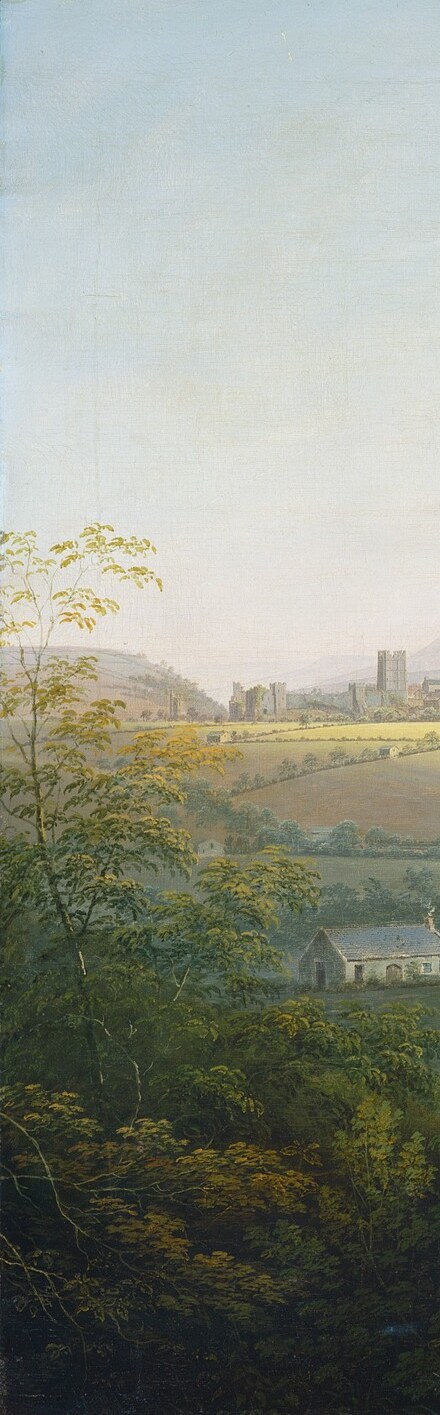
Easby Abbey, near Richmond by Cuitt the Younger, George

Easby Abbey, near Richmond, painted around 1854 by George Cuitt the Younger, hangs quietly in a long tradition of artists who buried their best details in the distance. The ruined abbey looks lost in empty hills, but the landscape is busier than it first appears.

Let your eye travel the valley floor and you will find a pale track, a strip of exposed earth still leading toward the ruin. Then look into the brightest patch of sky, at the horizon's centre-right. Small vertical marks resolve into a church tower and rooftops, the town of Richmond, sitting exactly where the haze is thinnest.

Cuitt was working in the early 19th century, when ruins were fashionable precisely because they stirred thoughts of time and loss. But by including the footpath and the living town, he refused the easy trope of total decay. The abbey crumbles while the world around it continues.

The painting rewards the patient viewer. What did you notice first, the ruin or the town?

#arthistory #britishart #ruins

Details
A classic picturesque repoussoir device , the near-black canopy pushes the eye inward and deepens the sense of an enclosed valley theatre around the ruins
Painted with loose, undifferentiated strokes; its deliberate emptiness , no figures, no livestock , heightens the solitude and lets the ruins read as the sole focal point
Mirrors the left tree to form a compositional arch; together the two dark masses make the luminous centre feel like a stage reveal
The painting's brightest zone and emotional engine , diffused afternoon sun bleeds around soft cumulus and silhouettes every distant ridge; this is where the atmospheric-perspective technique is most legible
Five or six distinct ridges step back into haze, each lighter and bluer , a textbook demonstration of aerial perspective situating the abbey within a broad Yorkshire landscape
Transcript

Ruins of an English abbey. Green hills. Quiet sky. It looks completely alone. But this pale track still crosses the valley floor. Someone can still walk there. Now look into the brightest part of the sky. A town sits on the horizon. Faint but definite. The ruin was never truly abandoned. The painter knew what we would scroll past.