Untitled by Seu Family|Manaku
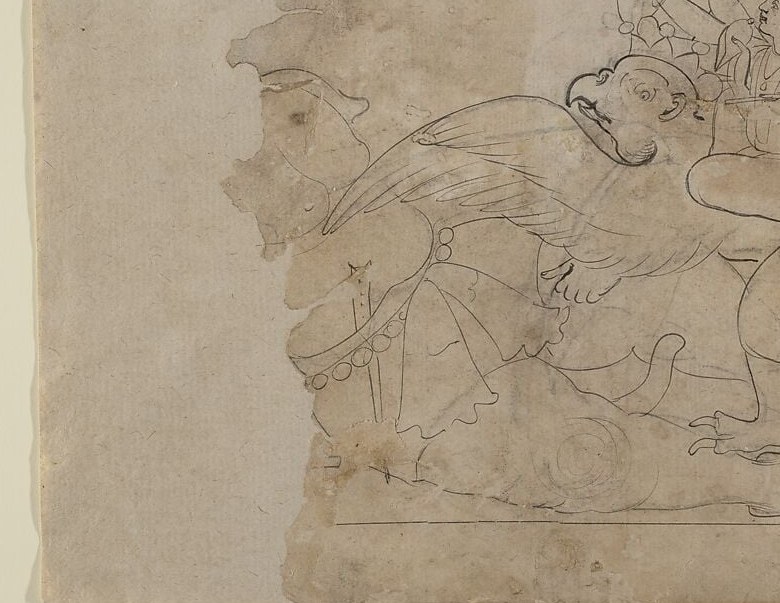
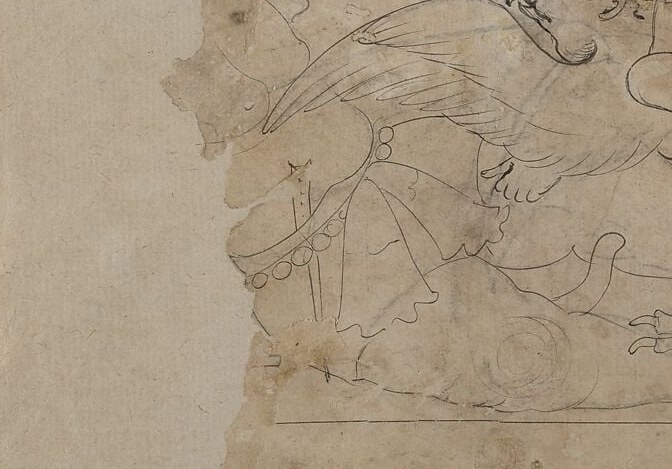
This is an untitled ink-and-wash painting from the Pahari Hills of northern India, made around 1740 and attributed to the artist Manaku. At first glance it reads as pure chaos: a monstrous demon body swells across most of the page. But the story, and the real action, is happening in the space above him.
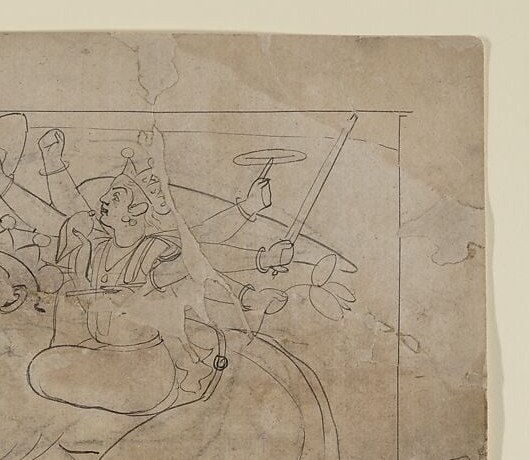
Look at the upper right corner. A small cluster of divine figures hovers there, led by the blue-skinned god Vishnu. He holds a discus and a conch shell, the attributes that identify him across centuries of Indian art. The scene depicts a cosmic intervention, Vishnu descending into demonic disorder to restore balance, a recurring theme in Hindu narratives.
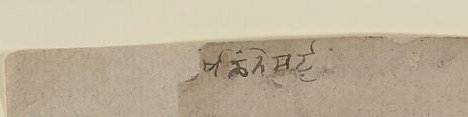
The two Devanagari inscriptions across the top are the real giveaway. They tell us this was never meant to be a standalone picture. It is a folio, a single page pulled from a larger illustrated manuscript, likely the Bhagavata Purana. Artists in the small hill courts produced these intimate, portable works for local rulers who wanted the great stories close at hand.
Next time you look, notice the technique: crisp ink contour lines laid down first to define the demon’s silhouette, then fluid washes floated in after to build three-dimensional mass. It is a window into an 18th-century workshop method, preserved on a sheet of bare paper.
#arthistory #indianart #paharipainting
Details
Transcript
Most people scroll right past this. A demon so massive it hardly fits on the page. Now look up, into the space above the chaos. A small cluster of divine figures hovers there. Vishnu, holding a discus and conch, descends to restore order. And up here, two inscriptions bracket the scene. This was never a standalone picture. It was a page in a book. Painted for a small Himalayan court, around 1740.