The young Louis XIV with his brother Philippe and his governess Françoise de Souvré, marquise de Lansac by http://www.wikidata.org/.well-known/genid/1c2d3b147249a60a490dee8c13f6e03c
This painting, "The young Louis XIV with his brother Philippe and his governess Françoise de Souvré, marquise de Lansac," created around 1643, offers a glimpse into the early life of one of France's most iconic monarchs. Displayed at the Palace of Versailles, it was commissioned to celebrate the young Louis XIV's ascension.
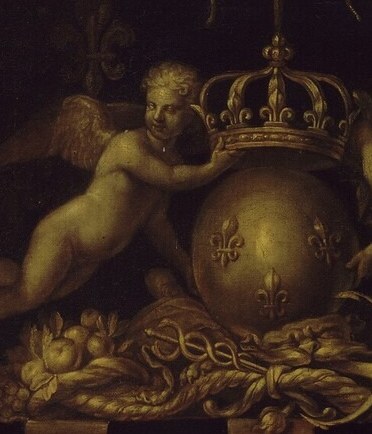
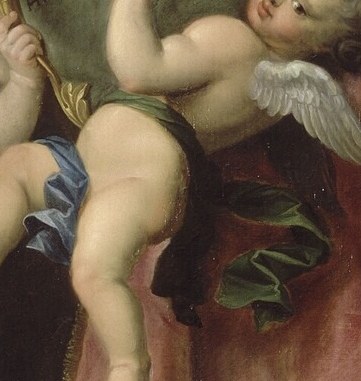
Notice the detailed symbolism: a cherub holding a crown foreshadows his future kingship, while another holds a scroll with an inscription reinforcing the concept of divine right. Even as a child, Louis XIV is depicted with an air of destiny, guided by his governess, Françoise de Souvré.
The work emphasizes the importance of lineage and royal education. It subtly hints at the absolutist reign that would come to define his rule, a period of immense power and, often, scandal for the French court. The painting captures a moment of innocence on the cusp of a dramatic and influential reign.
What do you find most striking about this depiction of a future king?
Details
Transcript
This is Louis XIV, as a child, with his governess and brother. He became the 'Sun King,' France's longest-reigning monarch. Look closely at the cherubs above their heads. One cherub holds a crown, for Louis XIV. The other holds a scroll with an inscription. This scroll points to the divine right of kings. Louis XIV’s reign would soon be famous for its absolutism.