Fly Market by William P. Chappel
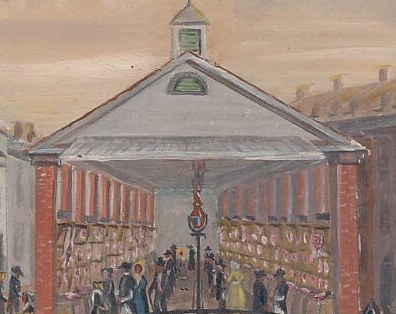
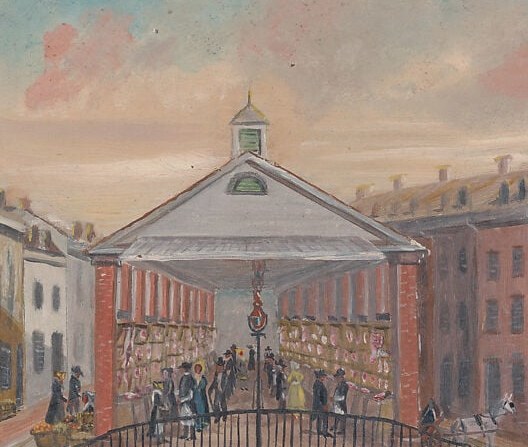
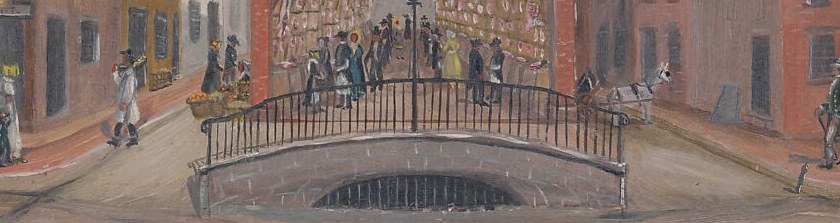
William P. Chappel’s 'Fly Market' is not a live sketch of a bustling afternoon. It is an act of memory, painted in the 1870s, a full half-century after the real building was torn down in 1821. What you see here is one of the only surviving visual testimonies to a vanished cornerstone of early New York commerce.
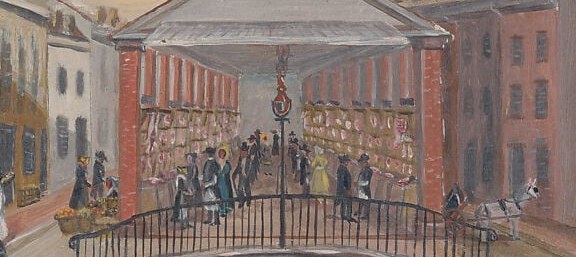
The painting centers on the columned market hall that gave the Fly Market its architectural dignity. Look past those classical columns and you can see faint structures receding into the upper center, a rare glimpse of the deep urban grid of old Manhattan. The ornate iron fence in the foreground is not just decoration; it was a real civic boundary that separated orderly citizens from the messy business of buying fish and produce.
Demolished to make way for a wider street, the market existed only in the memories of older New Yorkers by the time Chappel reconstructed it. He painted on an unconventional support, oil on slate paper, whose dark, non-absorbent surface makes the figures pop with a strange, lantern-lit contrast. The texture of the foreground pavement may even be the slate itself showing through, a direct material link to the gritty street he was trying to summon back.
What does it mean to paint a place that no longer exists, not from photographs but from a long life lived in the city?
Details
Transcript
New York built this market to be a monument. Classical columns for a fish stall. That was the ambition. Look past the columns, into the receding city. The Fly Market was demolished in 1821. This painter reconstructed it fifty years later, from memory. Notice the iron fence. He remembered the rules of the street. His surface was not canvas but slate paper. The stone beneath the paint is a ghost of the lost pavement.