竹に翡翠図|Kingfisher and Bamboo by Sesshū Tōyō (Japanese, 1420–1506)
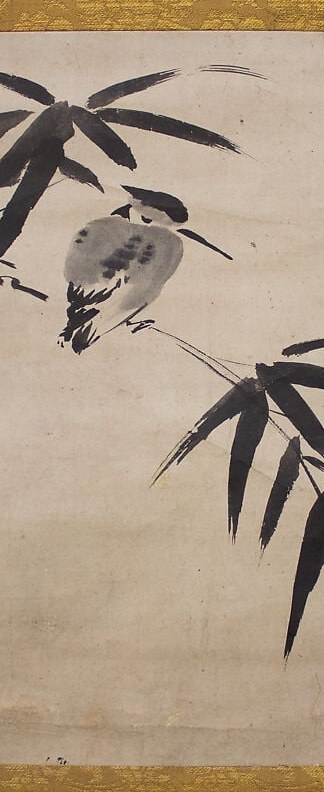
This is “Kingfisher and Bamboo,” a hanging scroll after Sesshu Toyo, the great 15th-century Japanese Zen monk and ink painter. The original was painted in 1463. That work was lost long ago. What you see here is a later copy, made deliberately to carry Sesshu’s composition forward into the future.
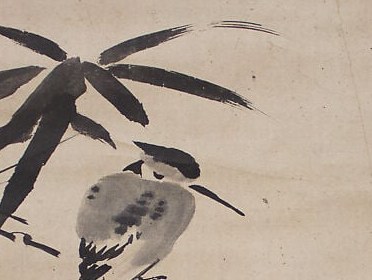
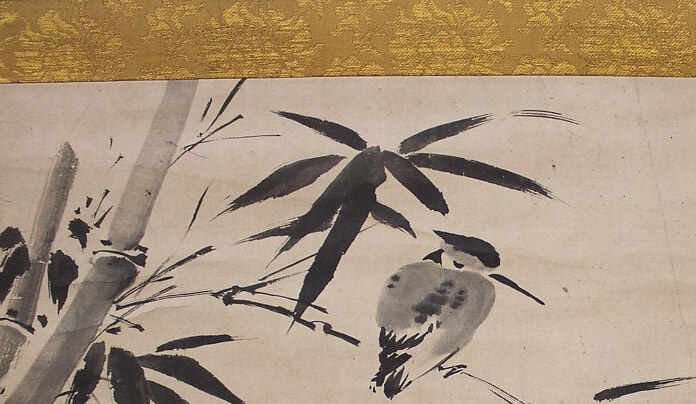
Look past the bird for a moment and study the bamboo leaves. Each one was made with a single decisive flick of the brush, the pressure varying as the ink ran out. The dark upper leaves anchor the composition; the lower leaves thin and lighten toward the right, creating depth in empty space. The bird’s grip on the central stalk is told in three or four strokes. Sesshu’s economy is the whole point.
Sesshu Toyo (1420-1506) was born into a samurai family, trained as a Zen monk at Shokoku-ji in Kyoto, and later traveled to Ming China. He absorbed Chinese literati ink painting and fused it with a Japanese Zen aesthetic: flattened space, emphatic line, and the idea that painting was itself a spiritual discipline. He became the most revered ink painter in Japan, and many later schools claimed him as their founder.
A copy can feel like a disappointment until you realize what it is preserving. Without this scroll, we would have no record of Sesshu’s kingfisher at all. The painting you see is not just a picture. It is a message that someone in the 19th century decided was worth saving.
Details

Transcript
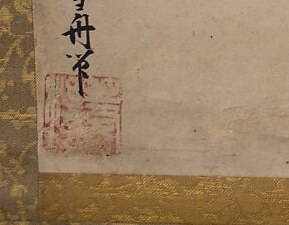
A kingfisher alone on a bamboo stalk. Painted in 1463 by a Zen monk named Sesshu. He had traveled to China and brought back this ink style. Look at the leaves. Each one is a single swift stroke. The artist's seal at lower left marks the work as authentic. And the gold brocade border signals a formal treasured scroll. But this scroll is not the 1463 original. That one is lost. This is a faithful copy, made to preserve Sesshu's vision.