View of New York from New Jersey by Asher Brown Durand
Asher Brown Durand's 'View of New York from New Jersey,' painted around 1850, is a masterclass in atmospheric perspective. Before he picked up a brush, Durand spent decades as an engraver, carving impossibly fine lines into metal plates for banknotes and book illustrations. That training never left him. What looks like a soft, hazy sky is actually built from thousands of tiny, deliberate strokes.
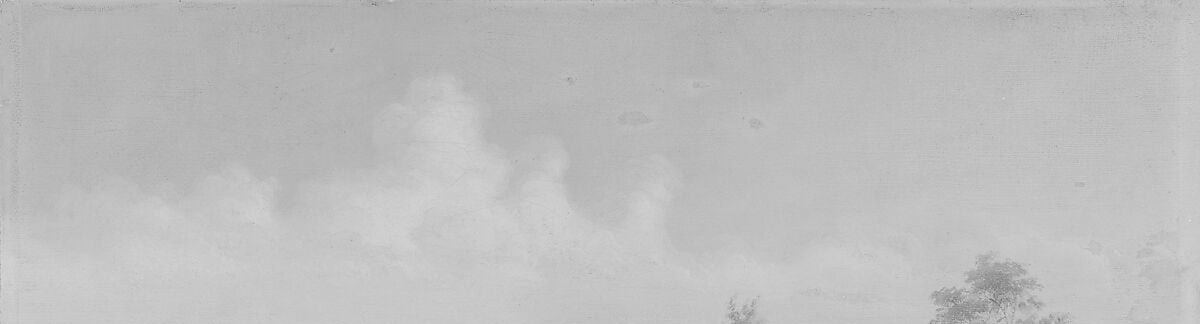
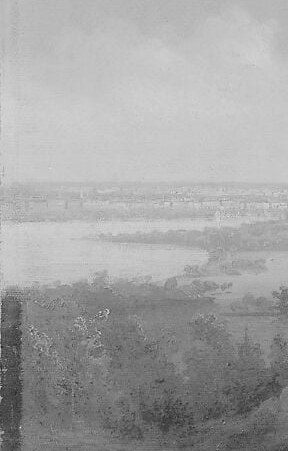
Stand back and your eye goes straight to the sky. It takes up nearly half the canvas, a billowing architecture of light and cloud that makes the distant city feel almost weightless. Now look at the horizon: a thin silvery band where smoke from the city, moisture from the river, and pure distance merge into a single luminous glow. There are no hard lines there, only tone graduating into tone.
Durand was a founding figure of the Hudson River School, a group of painters who believed nature was a direct path to the divine. He walked the New Jersey Palisades again and again, sketching trees and riverbanks in pencil before translating them into oil in his studio. Friends said he talked to the trees while he worked. This painting is his quiet argument that light itself could be a spiritual subject.
Housed in the American Wing of a major collection, the canvas captures Manhattan before the skyscrapers, a city seen from a safe pastoral distance. The effect is breathtakingly simple and nearly impossible to do. Next time you see a painting where the air itself seems to glow, look closer, someone made a thousand small choices so you could feel that light.
Details



Transcript
Look at the sky. It takes up half the painting. It is the painting. Down here, a thin band of silvery light. Haze, smoke, and distance merge into one glow. No hard edges. Just tone graduating into tone. This painter was an engraver first. He built images out of tiny lines. Thin layers of oil, each catching the light differently. That softness is a thousand decisions, each one invisible.