狩野探幽筆 『画苑』|Famous Themes for Painting Study Known as “The Garden of Painting” (Gaen) by Kano Tan'yū
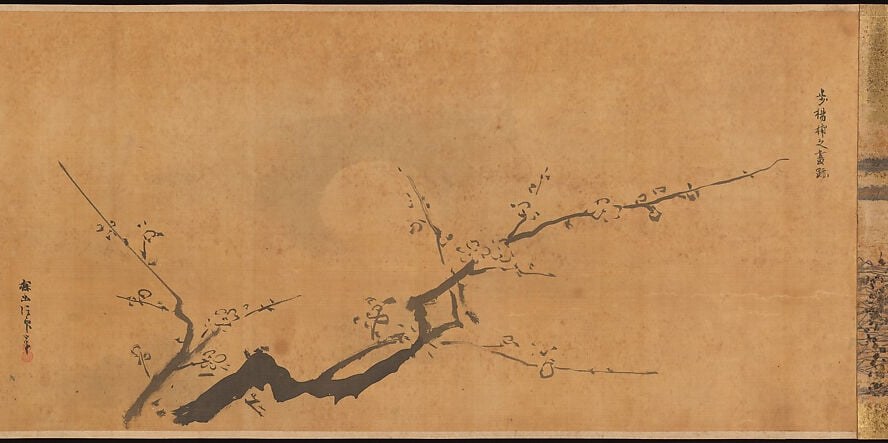
This is a page from 'The Garden of Painting' (Gaen), a handscroll made around 1670 by Kano Tan'yū, the official painter to the Tokugawa shogunate. It was never meant for display. It is a textbook, a complete visual curriculum designed to train the next generation of Kano school apprentices.
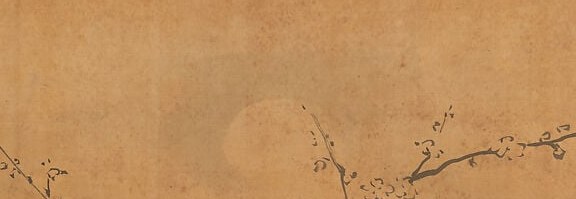
Look at the plum branch. The buds are rendered as the smallest possible ink dots, not full blossoms. That restraint is the lesson. A student learned to communicate late-winter dormancy through what was withheld, not what was painted. The trunk itself was a technical exam: rendered in one continuous gestural stroke that graduates from heavy, gnarled pressure at the base to the finest hairline tip at the uppermost branch. That single stroke contains the entire tonal range of ink painting.
The scroll is a catalog of standardized motifs, each paired with a poetic inscription that provides the correct literary mood. By copying these vignettes, apprentices absorbed not just brush technique but the cultural and emotional register that a plum branch, a scholar beneath pines, or a waterfall was supposed to carry. It was a system for mass-producing mastery.
Kano Tan'yū died in 1674, four years after compiling this scroll. The textbook outlasted him by centuries, preserving the canonical imagery that defined Japanese painting for generations. What looks to us like a spare, beautiful sketch was, to its first viewers, a machine for transmitting an entire cultural tradition.
Details

Transcript
This is not just a painting of a plum branch. It is a page from a textbook. 1670. The text names a poem. The image shows the mood. Students learned to read a season through restraint. Tiny ink flecks, not full blossoms. Late winter. The trunk was a single lesson in brush pressure. From thick gnarled base to hairline tip, one gesture. The painter ran the Kano school. This was the curriculum.