狩野常信筆 四愛図 |Four Admirers by Kano Tsunenobu
Kano Tsunenobu's "Four Admirers" is an Edo-period hanging scroll, ink and color on silk, now quietly held by the Indianapolis Museum of Art at Newfields.
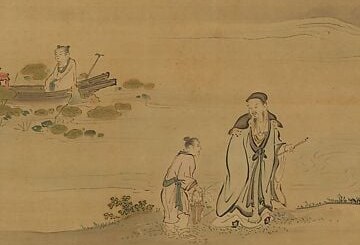
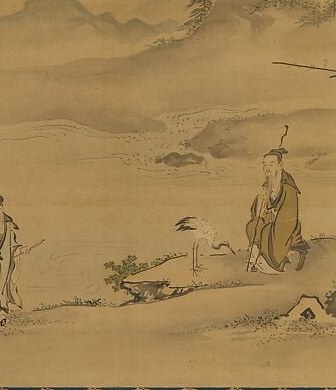
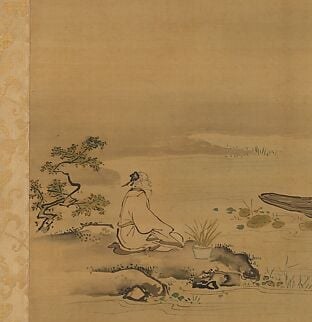
The painting places four scholars alone in four boats on a broad river. They do not face one another, and they do not speak. The rightmost man holds something small and white, a folded fan, open just enough to read. The fan is the key. In Chinese and Japanese literati tradition, scholars on boat outings composed impromptu verse, often writing it directly onto fans. This is not a painting of loneliness. It is a painting of poetry about to happen.
Most of the silk has no paint on it at all. The aged amber ground serves as water, mist, and open sky simultaneously, a material and conceptual feat that rewards a long, slow look, especially where the left margin dissolves into nothing.
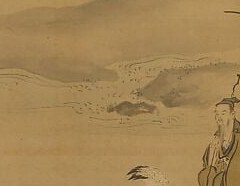
Kano Tsunenobu led the official Kano academy in Edo at the height of its power, serving the Tokugawa shoguns. The academy prized control, clarity, and legible subject matter. Here, Tsunenobu gives himself over to atmosphere: in the mokkotsu, or boneless, ink wash of the far mountains, pigment blurs into silk so gradually that the rock face breathes into the air. It is the same technique, from the same studio lineage, that would later influence the Nihonga revival.
A fan, a boat, a patch of open silk. Sometimes the most restrained painting carries the clearest invitation.
Details

Transcript
Four men. Four boats. A quiet river. No one speaks. Each sits utterly alone. The painter, Kano Tsunenobu, led the Edo shogun's official academy. Everything here is deliberate. Even the empty silk. That emptiness is the river, the mist, and the sky all at once. Now look at what the rightmost scholar is holding. It is a fan. A single unfolded fan. They are not here to study. They are here to write poetry.