Sunlight and Shadow: The Newbury Marshes by Heade, Martin Johnson
Martin Johnson Heade painted Sunlight and Shadow: The Newbury Marshes around 1871 to 1875, and it lives now at the National Gallery of Art in Washington, D.C. Heade was not a painter of grand mountain vistas. He was an obsessive student of the flat Massachusetts tidal marsh, and he returned to the Newburyport fields again and again, chasing the same fleeting event: the moment a cloud shadow sweeps across sunlit grass.
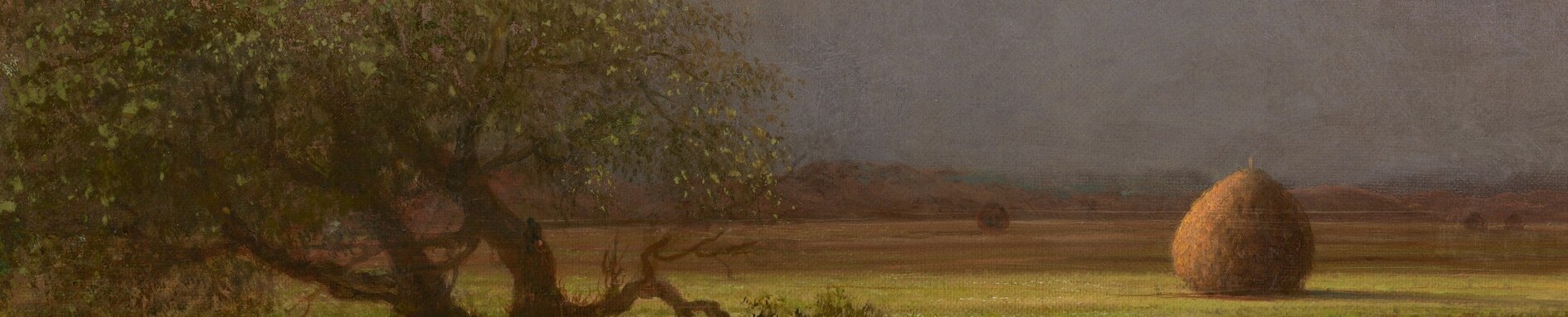
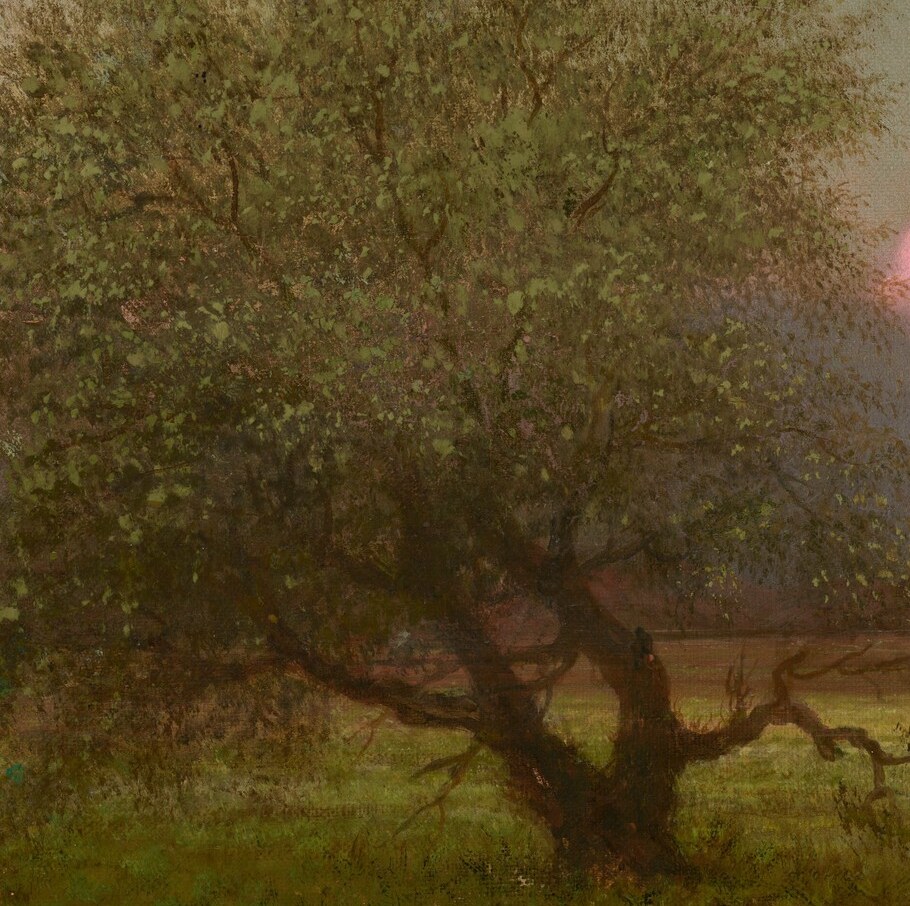
Run your eye across the picture from left to right. The left sky is a calm, leaden gray. Then the clouds boil up into pink-purple cumulus, lit fiercely from below. On the ground, a soft-edged band of darkness moves across the foreground hay. Look closely at that brightest cloud edge: the white-gold lip catching direct sun is barely a film of paint. Heade achieved that glow through glazing, thin, transparent layers of oil built up until the canvas itself seems to emit light.
This is Luminism, a strand of American painting that cared less about drama and more about atmosphere honestly observed. Heade’s trick was restraint: no visible brushwork, no theatrical gestures. The paint disappears, and what is left is the physical sensation of changing weather on a tidal flat. The solitary haystack, the wind-bent tree, the faint channel of water threading through the grass, all of it is scale for the sky’s performance.
He painted dozens of these marsh scenes, each a record of a specific hour and a specific slant of light. What do you notice first when you sit with this one?
Details



Transcript
It looks like a simple marsh. But this painter chased one thing for forty years. The exact second light turns into shadow. A band of darkness advances across the grass. Now look at the clouds. Lit pink from below by a sun you cannot see. He built that glow with layers of translucent oil glazes. The brightest spot is no thicker than a whisper of paint.