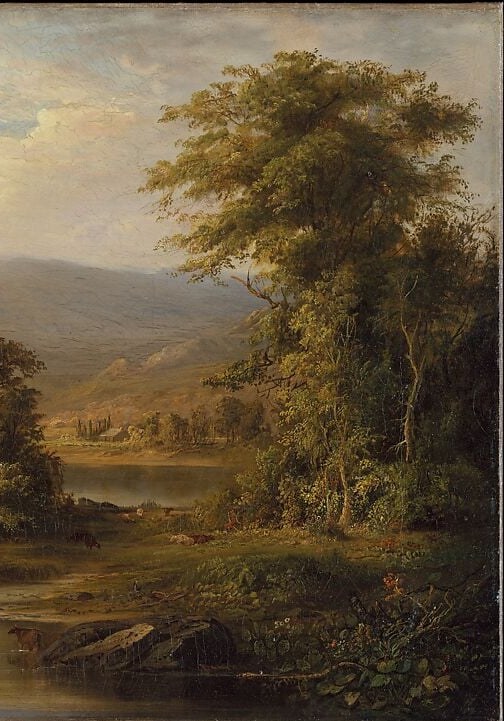
Landscape with Cows Watering in a Stream by Robert S. Duncanson (American, 1821–1872)
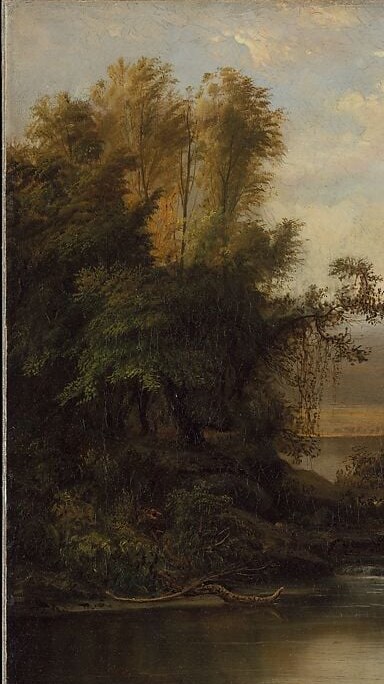
Robert S. Duncanson's "Landscape with Cows Watering in a Stream" (1871) is a small masterclass in aerial perspective, the technique of using color to measure distance. Duncanson, a second-generation Hudson River School painter and the first internationally known African-American artist, understood that the air between your eye and a mountain is not invisible. It is a faint blue filter.
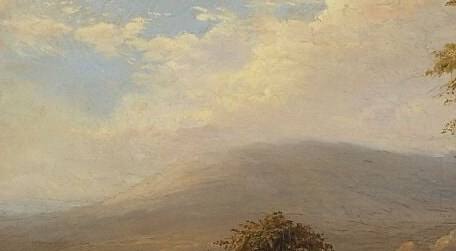
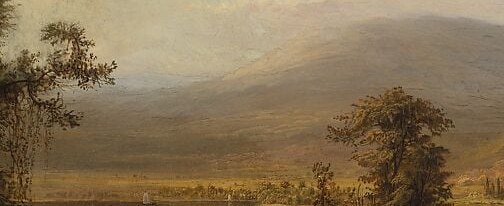
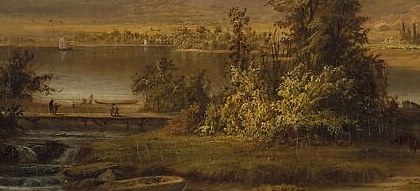
The painting reveals this in three bands. The near trees on the right are painted in warm browns and deep greens, the colors an object has when it is close. The middle meadow is paler, the green already cooling. The far mountain is a wash of soft blue-grey, its edges blurred by the atmosphere Duncanson has painted between us and it.
Duncanson made this work late in his career, in Ohio, where he had become a central figure in the Cincinnati art scene. He had traveled to Europe, seen the great landscapes, and brought back a command of light and atmosphere that rivaled any of his contemporaries. The painting now serves as a quiet record of an artist in full control of his craft.
What is remarkable is the simplicity of the trick. By shifting a color from warm to cool, the painter gives a flat canvas the depth of miles. Next time you look at a landscape, see if you can spot the blue.
Details
Transcript
Three zones: near trees, a meadow, a distant mountain. The trees on the right are warm brown and rich green. Now look at the mountain. It's the same mid-afternoon sun. But the color has shifted. Painters call this aerial perspective. Air has a color. Between you and the mountain hangs a pale blue veil of atmosphere. A Black artist in 1871, painting the physics of light.