The Pardon in Brittany by Pascal Dagnan-Bouveret
This is Pascal Dagnan-Bouveret's The Pardon in Brittany, painted in 1894 and now at The Metropolitan Museum of Art. When it debuted, it was attacked for being too beautiful to be true. The artist had spent years as the rising star of the French naturalist school, praised for his scientific, unflinching depictions of rural life. This painting was meant to be his masterpiece.
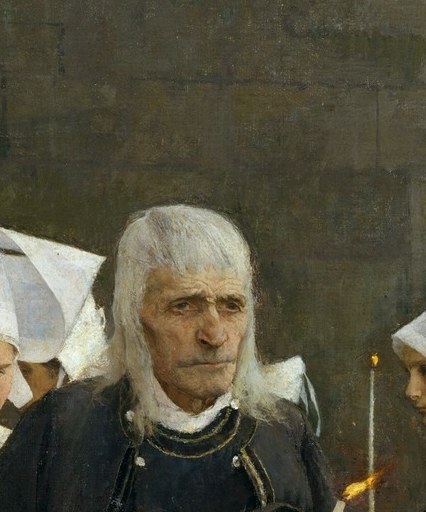
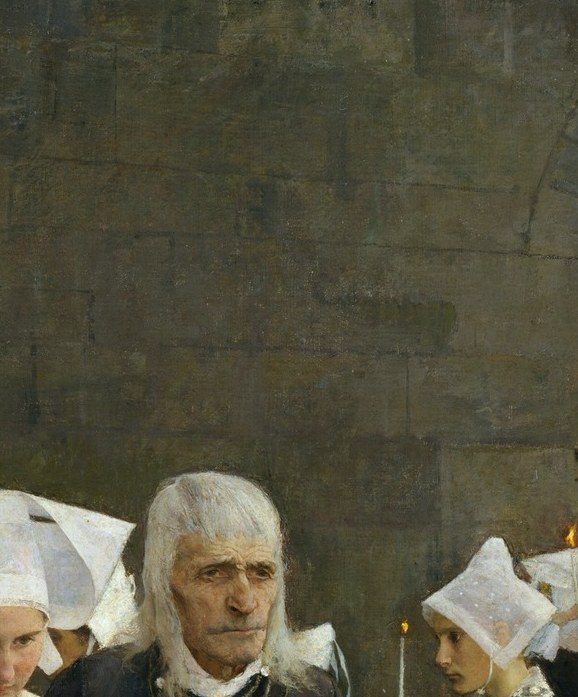
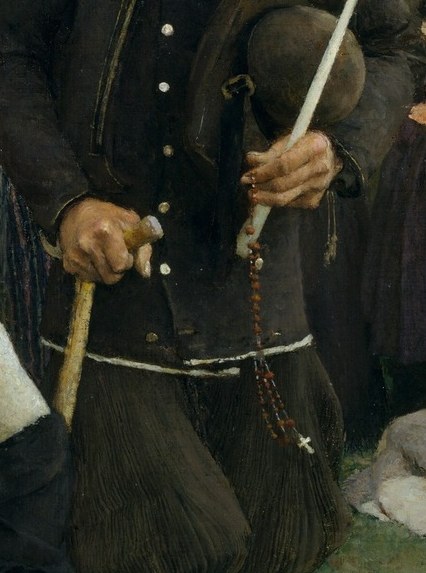
Look at the elder woman at center. Her weathered face, the parted lips, the eyes lifted upward, Dagnan-Bouveret built his career on faces like this, studied from life in the Breton countryside. The white coiffes are precise ethnographic markers of a regional culture he documented in repeated trips. And the candlelight falling across dark clothing is the painting's central technical device: a single light source, meticulously rendered, binding individual devotion into collective ritual.
But when the painting was shown, critics smelled a fraud. They argued that no authentic religious procession ever looked this perfectly arranged. The barefoot penitent at lower right, the choirboy at the far left margin, the gaunt elder woman transported into rapture, it struck them as a studio confection, not documentary truth. The charge was staging: that the artist had hired models, posed them under controlled light, and sold the result as observed fact. In the naturalist circles that had made his name, this was a serious accusation.
The controversy damaged him. Dagnan-Bouveret had been seen as the heir to Bastien-Lepage and the naturalist tradition; after The Pardon in Brittany, his standing never fully recovered. He continued to paint religious and symbolist subjects, but the movement that once claimed him as a leader moved on. The irony is that the painting now hangs in one of the world's great museums, admired for the very qualities that once made it suspect. Was it a record of faith, or a performance of it?
Details
Transcript
In 1894, a French painter unveiled his most ambitious work. He called it a faithful record of a Breton religious festival. Look at the elder woman's face. Critics said that face was a lie. They accused him of staging the whole scene in a studio. That the candlelight was not observed but invented. The scandal cost him his reputation as a naturalist.