Bay and Harbor of New York from Bedlow's Island by Edmund C. Coates
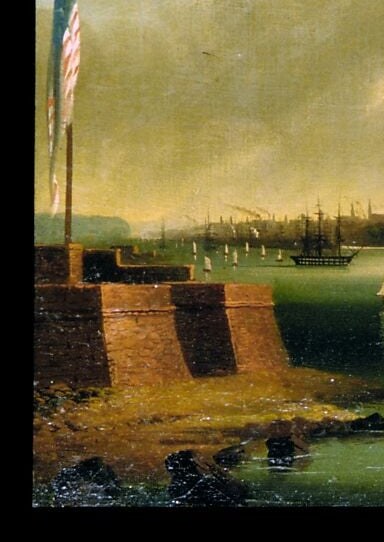
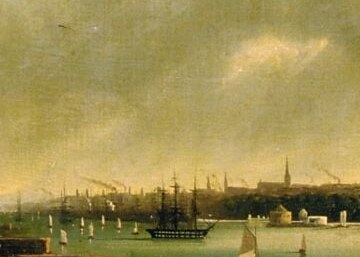
This is New York Harbor as seen from Bedloe's Island, painted by Edmund C. Coates between 1850 and 1860. The view is an eyewitness: it captures the exact spot where the Statue of Liberty's pedestal would be built decades later, looking toward a Manhattan skyline made entirely of church steeples and low warehouses.
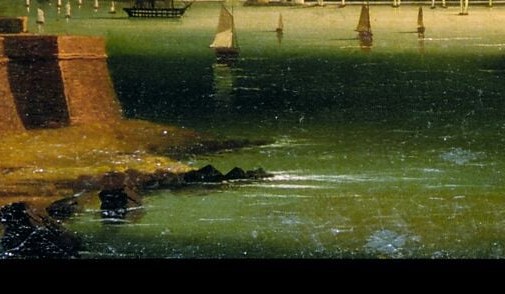
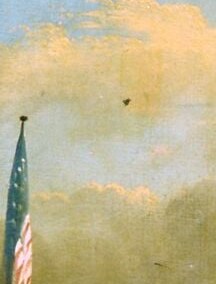
Look closely at the stone parapet in the foreground. That is Fort Wood, an active military installation whose star-shaped walls would soon become the statue's base. An American flag flies above it, marking federal sovereignty over the harbor. Across the water, the skyline is a horizon of spires, Trinity Church likely among them, with not a single skyscraper in sight.
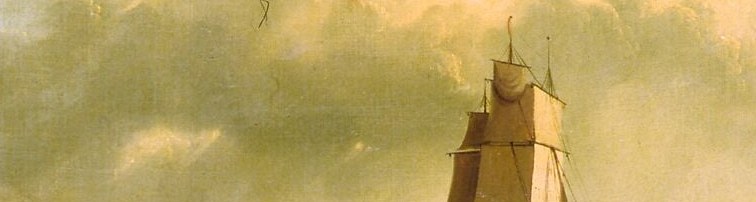
Coates painted during a transitional moment. In the harbor, tall ships and side-wheel steamboats share the water, sail and steam coexisting in a single frame. The painting documents the harbor's density too: count the masts on the right, and you begin to see how crowded New York Bay already was.
The entire silhouette of the city has since been replaced. The statue arrived in 1886, the Brooklyn Bridge opened in 1883, and the towers rose in the century after. This canvas is one of the few remaining views of a harbor whose skyline was still human-scaled.
Details
Transcript
New York Harbor, sometime between 1850 and 1860. You are standing on Bedloe's Island, looking toward Manhattan. That low skyline is all church steeples and warehouses. No Statue of Liberty. No skyscrapers. This is the city she would one day overlook. This stone fort beneath the flag is where her pedestal will be built. In the water, steam and sail share the same harbor. Edmund Coates painted a city whose entire silhouette has since been replaced.