元 王振鵬 維摩不二圖 卷|Vimalakirti and the Doctrine of Nonduality by Wang Zhenpeng
View the artwork: 元 王振鵬 維摩不二圖 卷|Vimalakirti and the Doctrine of Nonduality →
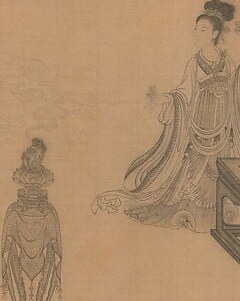
This is "Vimalakirti and the Doctrine of Nonduality," an ink-on-silk handscroll by the Chinese court painter Wang Zhenpeng, dated 1308. It stands as one of the earliest surviving Chinese paintings that is both signed and dated, a direct witness to artistic practice and Buddhist patronage under the Yuan dynasty.
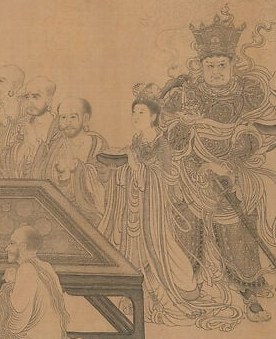
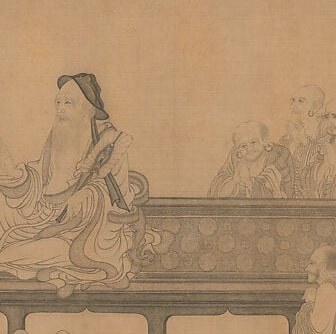
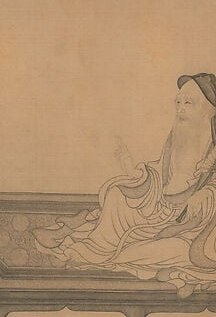
The scene centers on a philosophical debate. Vimalakirti, the lay scholar reclining on the raised daybed, feigns illness to gather an assembly. Standing opposite him is Manjushri, the bodhisattva of wisdom. Their exchange concerns the Mahayana Buddhist concept of nonduality, the idea that seeming opposites, such as self and other or existence and emptiness, are ultimately not separate. A crowd of monks, celestial beings, and court attendants surrounds them, their varied postures silently reacting to the argument.
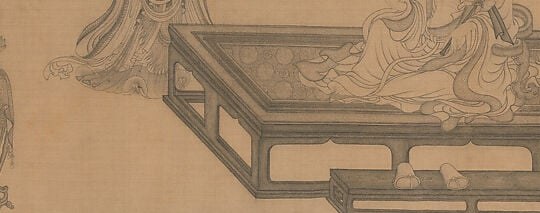
Wang Zhenpeng rendered this entire scene in the baimiao, or plain drawing, style: fine, unshaded ink contours with no color wash. Look closely at the drapery and you can see the sheer control required to define every fold with a single line weight. The technique descends from the Song master Li Gonglin, and Wang Zhenpeng's mastery of it made him a favorite at the Yuan imperial court.
A painting like this is both a philosophical diagram and a historical document. The carved legs of the daybed, the armor of the guardian, the cut of the white robe, all record the material world of 1308 Beijing as faithfully as the figures record a Buddhist sutra. What early dated painting from your own tradition would you most want to sit before?
#arthistory #chinesepainting #yuanart
Details
Transcript
This is not a sickroom. It is a philosophical debate. Vimalakirti feigns illness to draw an audience. The man facing him is Manjushri, the bodhisattva of wisdom. They are debating nonduality: that opposites are not truly separate. Every robe is drawn with unshaded ink contour lines. This baimiao style defined Yuan court draftsmanship. And this scroll is one of the earliest Chinese paintings both signed and dated by its maker. The artist, Wang Zhenpeng, painted it for the court in 1308.