清 袁江 九成宮圖 屏|The Palace of Nine Perfections by Yuan Jiang
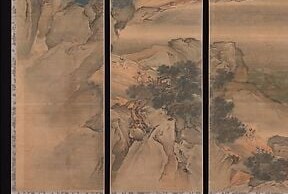
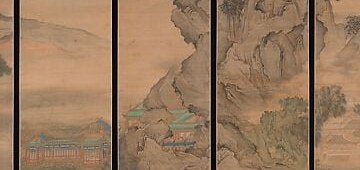
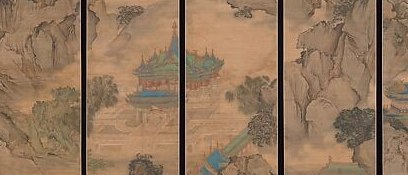
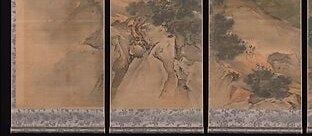
The Palace of Nine Perfections, painted by Yuan Jiang in 1691, is a palace that did not exist. The Tang dynasty's Nine Perfections Palace had been rubble for centuries. Yuan Jiang had no ruins to survey, no architectural plans to consult. He reconstructed it from surviving poems, historical descriptions, and his own formidable visual imagination, producing twelve hanging scrolls that read as one continuous panorama.
Look at how the perspective holds. This is jiehua, the demanding Chinese tradition of ruled-line architectural painting. Every roofline, every balustrade, every terrace recedes at a rational, measurable angle. The gate tower on the left anchors the composition. The mist bands do the hardest work: they thread between the scrolls, sharing a single consistent light source across all twelve panels so the seams disappear.
Yuan Jiang was active in Yangzhou around 1680 to 1730, working for wealthy merchants who wanted grand, imaginary landscapes. This piece, ink and color on silk, is among his largest surviving sets. It is now in the collection of the Metropolitan Museum of Art.
The figures in the courtyard are only a few millimeters tall. That choice is deliberate. The architecture is meant to feel overwhelming, because the subject is not the people but the idea of imperial power made visible. Walk the winding path in the lower left and see how far you can get.
Details

Transcript
This palace didn't exist when it was painted. No ruins to survey. No plans to consult. Yuan Jiang built it from old poems and brush and ink. Notice the perspective. Every roofline is rational. Twelve separate silk scrolls, and not one seam shows. He threads them with cloud bands that share one continuous light. A palace that never was, convincing enough to walk through.