Still Life: Fruit by Severin Roesen
View the artwork: Still Life: Fruit →
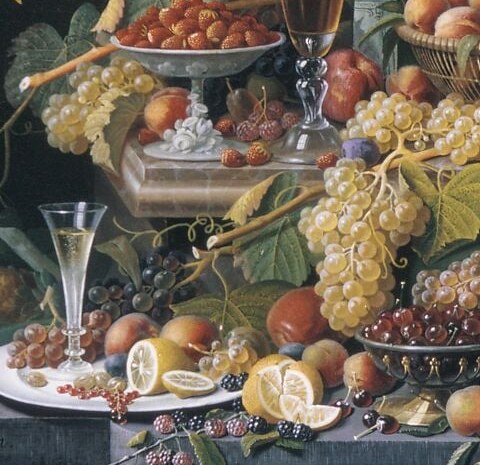
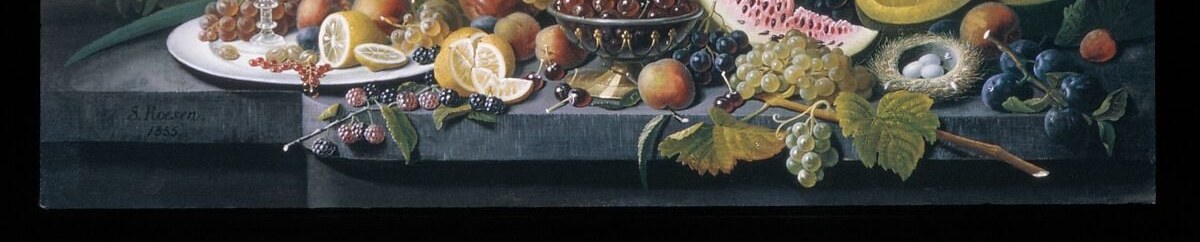
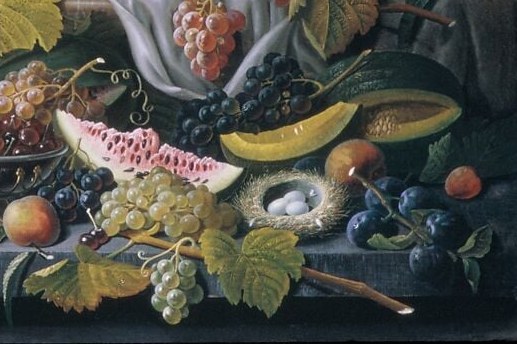
Severin Roesen's Still Life: Fruit, painted in 1855, is a technical audition disguised as a centerpiece. The German-born artist trained on porcelain before fleeing the 1848 revolutions for New York, and he brought that craft precision to canvas, every surface here is a distinct problem he solves in front of you.
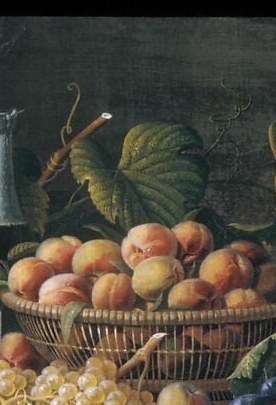
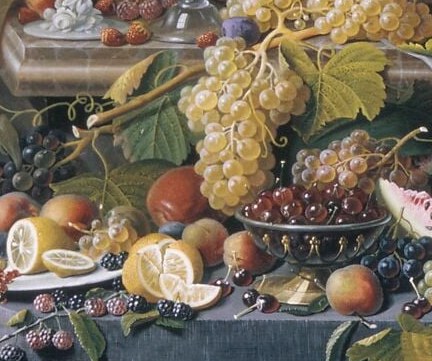
The champagne flute alone is a tour de force: bubbles suspended mid-rise, the liquid meniscus glowing from within, the glass itself rendered in transparent oil paint. Roesen then cycles through translucency (the grapes), soft broken strokes (the peach fuzz), and reflective metalwork, shifting his hand within a single composition to prove he could fake any material.
Find the silver compote on the left. Its convex surface reflects the surrounding fruit in miniature, a hall-of-mirrors trick that collapses the whole painting into a tiny curved image. Roesen tucked virtuoso flourishes like this into nearly every canvas; they function as a signature for those who slow down long enough to look.
He left New York for Williamsport, Pennsylvania in 1863, where lumber barons bought these lavish tableaux as affirmations of their own prosperity. The Metropolitan Museum of Art acquired this work in 1963. How many hidden signatures can you find?
#arthistory #severinroesen #stilllifefruit
Details
Transcript
Look at the champagne. Bubbles caught mid-rise. The meniscus lit from inside. Rendering glass in oil was a supreme illusionist trick. He learned it painting porcelain in Germany. Now scan the grapes. Each one is a tiny glass sphere. But the peach next to it? That required a different hand. Furred skin, a soft broken stroke. He shifts texture on a single canvas. Now look inside the silver compote's curved bowl.