The True American by Enoch Wood Perry
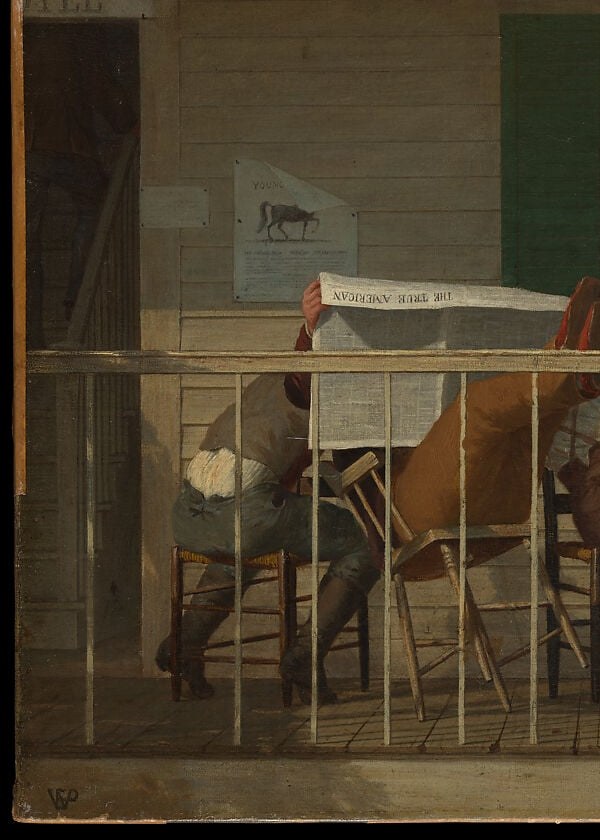
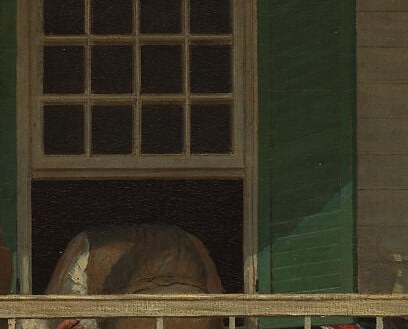
Enoch Wood Perry's *The True American* (ca. 1874) is a genre painting that functions as a political argument. The title isn't a joke or a nickname, it's a thesis. Perry, a Boston-born artist who worked in Philadelphia, New Orleans, and New York, set out to paint the ordinary citizen as the real foundation of the country, and every object in the frame carries that weight.
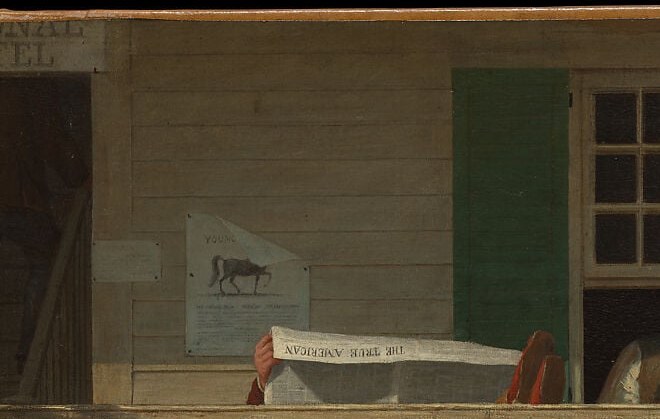
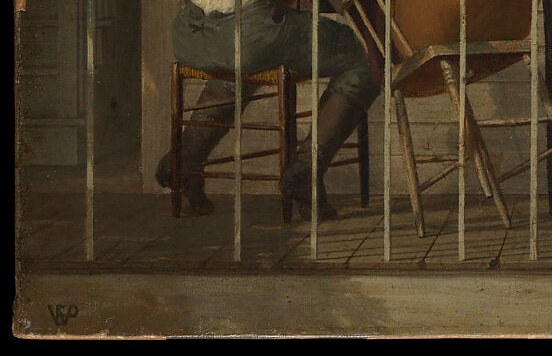
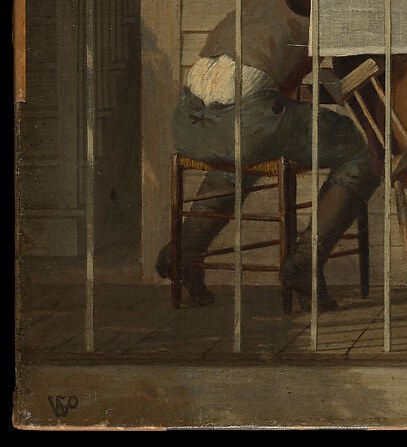
Look at what Perry gives him: a plain ladder-back kitchen chair, work-worn boots planted on bare ground, and a newspaper that literally replaces his face. By hiding the man's identity, Perry turns him into an archetype. The horse beside him is not a prop, it pairs civic literacy with frontier practicality, two halves of the claimed American character.
Perry painted this in the mid-1870s, less than a decade after the Civil War ended and during the turbulent Reconstruction years. It was a moment when the question of who counted as a true American was being violently contested. Perry's answer, a laborer reading the news on a porch, was a deeply populist one, elevating everyday civic engagement above wealth or military glory.
His face is hidden, but the newspaper is lit like a portrait. What do you think Perry would have painted if the title was *The True American* today?
Details
Transcript
The title isn't a person. It's an argument. A working man reads the news. His face is hidden. He is every citizen. His boots are worn by labor. He sits in a plain kitchen chair, not a throne. The horse beside him: the frontier, patient and practical. Perry painted this in 1874. The Civil War was nine years over. The true American wasn't a general or a senator. He was the one reading.