琴棋書画図屏風|The Four Accomplishments by Kano Motonobu
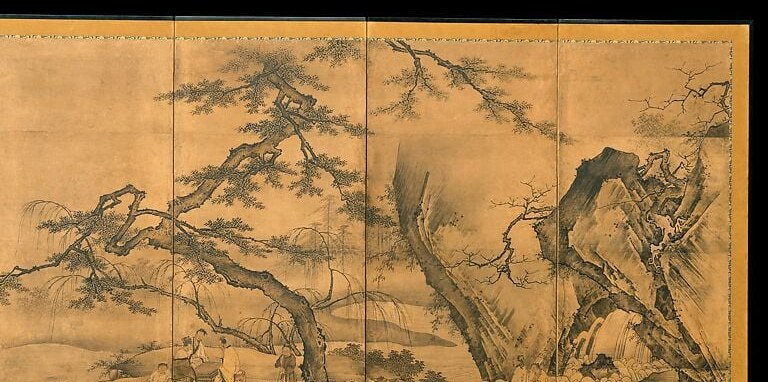
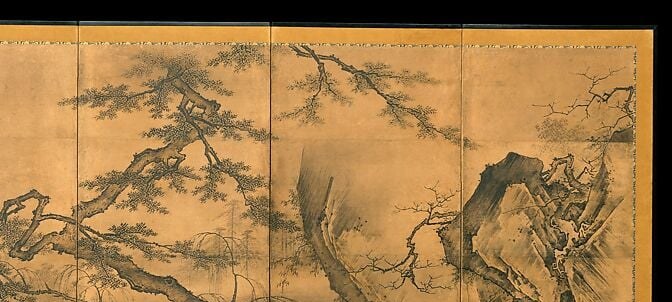
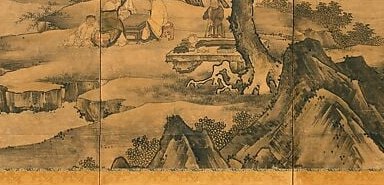
A single pine tree taught Japanese painters for two centuries. This is 'The Four Accomplishments,' a pair of six-panel screens by Kano Motonobu, created around 1550 and now held by the Metropolitan Museum of Art. It illustrates the four scholarly pursuits of the ideal gentleman, music, chess, calligraphy, and painting, but the real subject is power, transmitted through a branch.
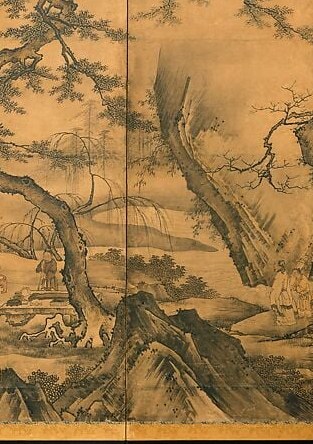
Look at the pine needles fanning out in the upper right. Motonobu did not paint from nature alone; he engineered a repeatable stroke, quick, overlapping, radial, that his students could copy exactly. The angular, calligraphic branches are a synthesis of Chinese Song-dynasty brushwork and Japanese decorative flatness. Every line in this tree was a lesson, and the lesson worked. This screen became the model for the Kano school's official style.
Motonobu (1476-1559) was the second head of the Kano school and the strategist who made it a dynasty. By securing the patronage of the Ashikaga shogunate, he positioned his workshop as the default choice for the military elite. If you were a daimyo who wanted to look cultivated and commanding, you commissioned a Kano screen. The demand was so consistent that the school's curriculum fossilized around Motonobu's pattern books, including this very pine, for generations.
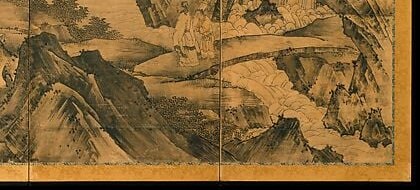
The vast, unpainted gold ground on the left is not empty; it is the sound of water implied by paper itself. Mist bands are bare gold left to glow rather than recede. Motonobu understood that in a folding screen, the support is the starring material. The scholars beneath the tree are tiny, their Confucian hierarchy made spatial: nature dominates, human activity nestles within it. The school Motonobu built would define official Japanese painting until the 19th century, all starting from the disciplined ink lines of one gnarled trunk.
Details
Transcript
For over 200 years, almost every Japanese painter learned this one tree. Every brushstroke was a lesson. Students copied these branches exactly. Look at the pine needles. They fan out like a textbook diagram. This precise, radial stroke became the official signature of the Kano school. The painter was Kano Motonobu. He ran the most powerful workshop in Japan. He got the shogun's commission. Then every warlord wanted a screen like this. But the technique itself was the real monopoly. No scandal here. Just a quiet, total takeover of a nation's visual imagination.