Taking the Census by Francis William Edmonds
This is “Taking the Census,” painted in 1854 by the American artist Francis William Edmonds. It is held at the Metropolitan Museum of Art. On the surface, it is a calm genre scene of a family receiving a government official, but the real story lies in who is not being counted.
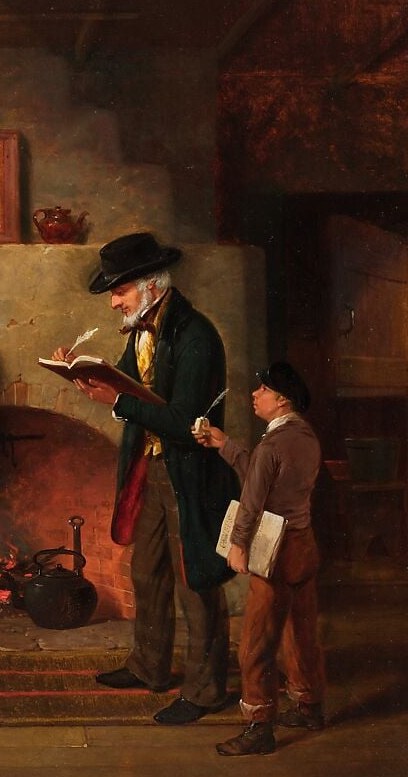
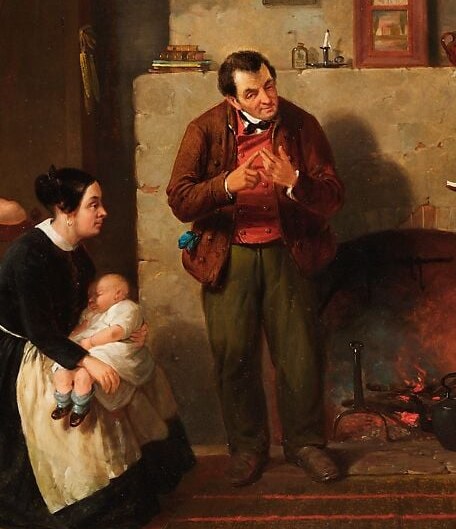
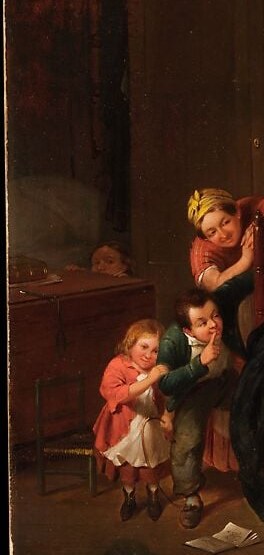
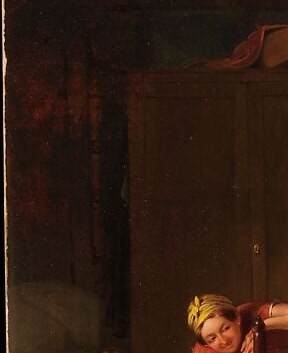
Look first at the central exchange: the census taker holds his ledger with a pen at the ready, while the mother cradles her infant with a guarded posture. The official’s tricorn hat signals his civic authority, but the warm light of the fireplace behind him asserts that this is her domain. Then, let your eye drift to the far left of the canvas. In the shadows of a doorway, you will find two more small children peering in. Edmonds is quietly asking: is the count ever really complete?
Edmonds was a bank cashier who feared his paintings would damage his financial career, so he first exhibited under a pseudonym. By the time he made this work, he was a full Academician, using the meticulous realism of the Dutch masters to document American life. The painting is an exercise in dual vision: the state extracts names and ages, while the disengaged boy in the corner seeks knowledge privately in his book, oblivious to the official.
Look one more time above the fireplace. A framed portrait of a man, likely an ancestor, hangs on the wall. He is present in the home but absent from the ledger. The census records the living, while the dead, and even some of the living in the shadows, slip through the lines.
Details
Transcript
They say a census counts every soul in the house. The official’s pen is poised over the open ledger. A mother and her children meet the state’s intrusion. But the boy in the corner refuses to look up. Look in the doorway. More children linger there. And above the hearth, one figure will never be counted.