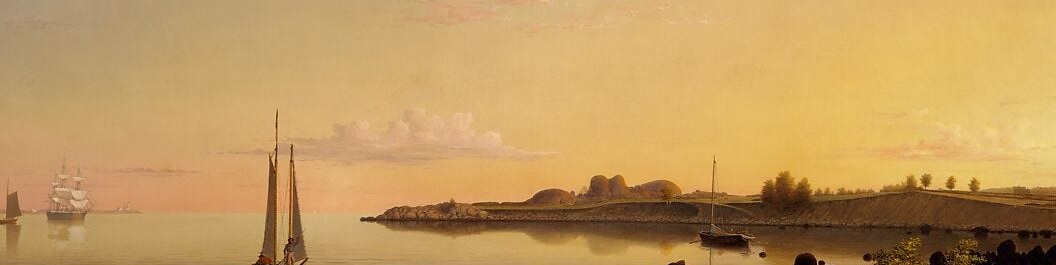
Stage Fort across Gloucester Harbor by Fitz Henry Lane
Fitz Henry Lane painted Stage Fort across Gloucester Harbor in 1862, the single bloodiest year of the American Civil War. It hangs now in Gallery 761 of the Metropolitan Museum of Art. Shiloh, Antietam, and Fredericksburg all fell within these twelve months. Lane, living in Gloucester, Massachusetts, looked at the harbor and painted something that refuses to acknowledge a wound.
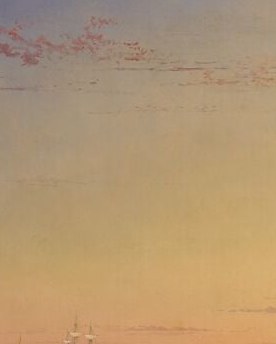
Look at the water first. Lane has rendered it so motionless, so perfectly mirror-still, that it fuses with the sky along a thin incandescent band of gold. The horizon nearly disappears. That collapse of sea into air is not meteorology; it is a spiritual argument. The small schooner on the left and the ghost-ships dissolved into the distant haze are the only hints that this is a working port, not a dream. The foreground rocks are the only surface with texture, and they make the water's stillness feel willed, a decision, not an accident.
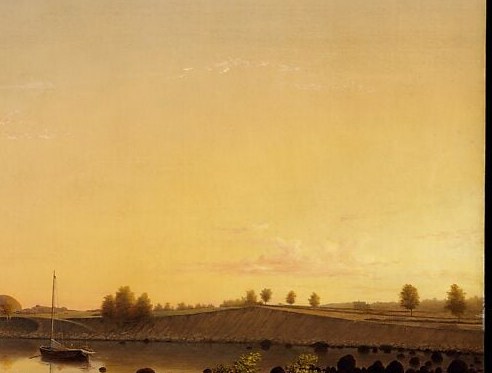
Stage Fort itself, the painting's nominal subject, was a former military installation. Lane reduces it to a dark, quiet silhouette on the right. The fortifications are present but the guns are invisible. He was painting from memory, as he often did, and what he chose to remember was peace. Lane had been painting New England harbors for decades, developing a style later called Luminism, where light itself becomes the subject. By 1862, his work had grown quieter and more spare, a curving spit of land pulling the eye from textured detail into vaporous dissolution.
We cannot know if the stillness was escape, protest, or simply a refusal to let the war into the frame. The painting does not answer. It only holds the light.
Details

Transcript
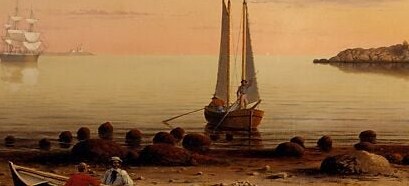
1862. Shiloh. Antietam. Fredericksburg. Here, in Gloucester, the same year. Not a single brushstroke admits there is a war. The water reflects the sky so perfectly you lose the horizon. That stillness was the point. Lane painted an argument for peace. The fort itself is barely a silhouette. Its guns are invisible. And these figures by the water's edge, they are the only sign of life.