Saint John the Evangelist in Patmos by Juan Bautista Maíno
Juan Bautista Maíno's "Saint John the Evangelist in Patmos," painted in 1612 and held at the Museo del Prado, depicts a moment of serene isolation with hidden depths. It portrays Saint John during his exile, a period traditionally associated with his writing of the Book of Revelation.
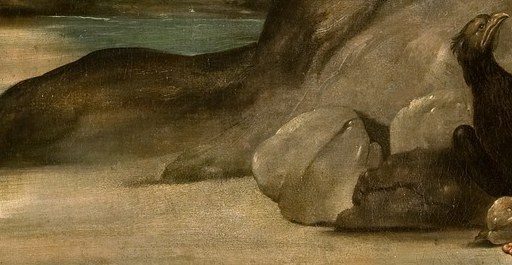
Observe the details: the open book, the symbolic eagle at his feet, and the play of light on his face. Then, allow your eyes to travel past the rocky shoreline and the calm, expansive sea. You might spot a small, almost imperceptible ship on the distant horizon, a subtle reminder of the world beyond his spiritual solitude.
Maíno was a master of chiaroscuro, using strong contrasts of light and shadow to imbue his scenes with dramatic depth and a luminous quality. This technique enhances the quiet intensity of Saint John's experience, making the painting a profound meditation on faith and isolation.
What other small details do you notice that add to the painting's powerful atmosphere?
Details
Transcript
Saint John the Evangelist, exiled on the island of Patmos. He is believed to have written the Book of Revelation here. The eagle is his traditional symbol, representing divine insight. Look closely at the distant horizon, past the calm sea. A small ship, barely visible, hints at the world beyond. This painter was known for meticulous detail and light.