清 孫榮 觀鵝圖 扇頁|Two Scholars and Boy with Goose by Sun Rong
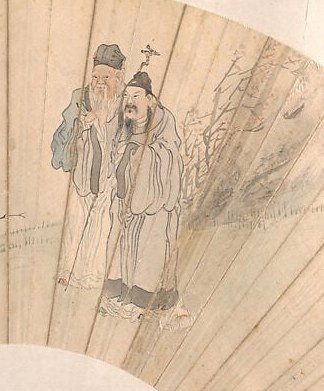
Sun Rong's 'Two Scholars and Boy with Goose' (1849) is a deceptively simple fan painting whose real subject is the silent language of aesthetic exchange. Painted in ink and color on silk for the intimate circles of Qing literati, it turns a small domestic moment into a philosophical dialogue.
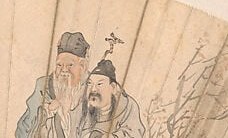
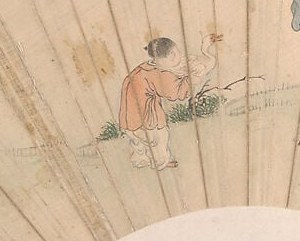
Look first at the scholar's face. His downward gaze does the real work of the composition, linking him directly to the child and the goose below. The boy's low crouch signals deference not to the man alone, but to the ritual of presentation. Then notice the goose itself: painted with the finest dry brushstrokes, every feather distinct. The bird is no mere poultry. It invokes Wang Xizhi, the fourth-century calligrapher so revered that a single exchange of geese for a copied sutra became an eternal emblem of what scholars value, beauty over wealth, nature over position.
Sun Rong worked in the long twilight of the Qing dynasty, deliberately continuing classical styles when the world was changing fast. The work was likely a personal gift, an offering between friends who understood the goose's hidden lexicon. Bamboo frames the scholar, confirming his virtue without a word of text. The fan's curved edge alters each figure's horizon line, a spatial puzzle unique to the format.
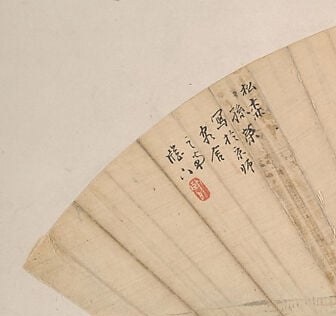
The vertical colophon visible on the left may carry the very poem that unlocks the scene's private meaning. Until someone reads it fully, we are all standing just outside the frame, watching a conversation whose secrets we only half know.
Details
Transcript
A gathering on a silk fan, painted for a private circle in 1849. The eye is drawn down, past the standing scholar. Past his absorbed, downward gaze. To a boy, crouching low, guiding a single white goose. The goose is a tribute to Wang Xizhi, the greatest calligrapher who ever lived. Legend says he once traded an entire sutra just for a flock of them. Here, a child presents the bird; a scholar receives it without a word. The poem inscribed here likely holds the key, still unread.