Vétheuil in Summer by Claude Monet
Claude Monet painted "Vétheuil in Summer" in 1880, looking across the Seine at the small commune where he lived with his family. It is now in the collection of the Metropolitan Museum of Art. The painting captures a specific place at a specific hour, but it also preserves something larger: a way of life on the river that has vanished.
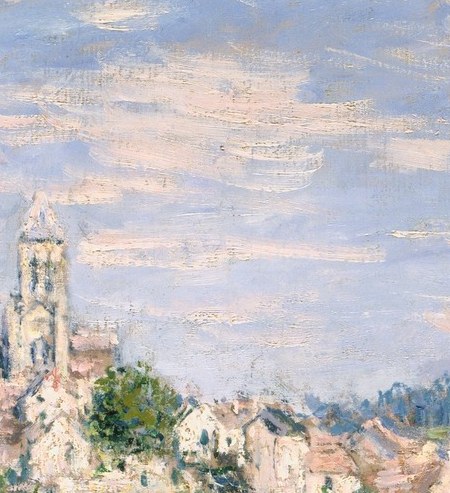
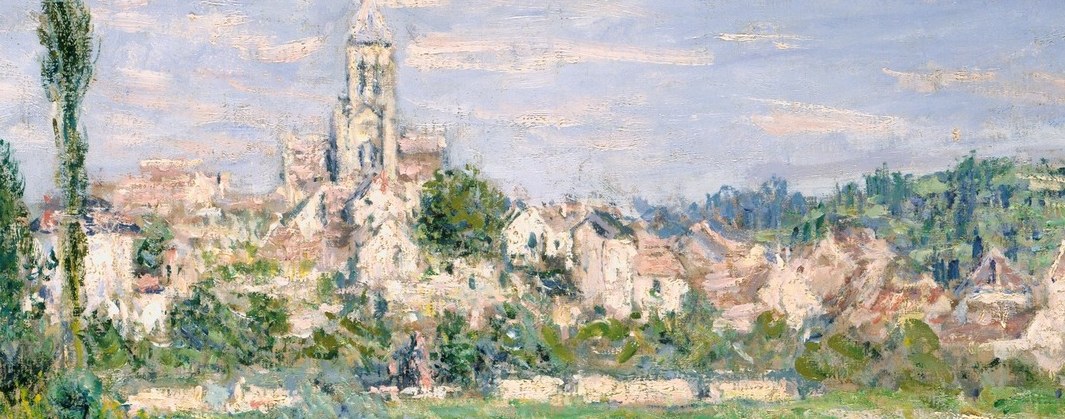
Your eye goes first to the church bell tower, the vertical anchor of the whole composition. That tower was a practical landmark for boatmen navigating this stretch of the Seine. Below it, the village rooftops are rendered in warm ochre and white, almost dissolving into the summer foliage. Monet refuses to separate architecture from nature; the buildings and trees are painted with the same loose stroke, as if the town grows organically from the hillside.
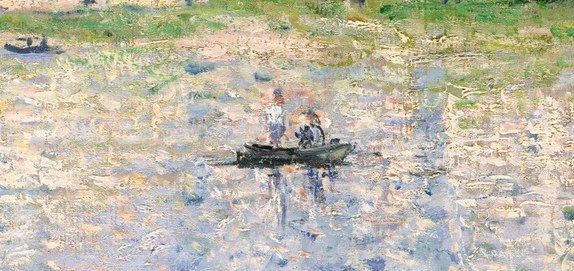
Monet moved to Vétheuil in 1878, a difficult period when he was struggling financially and caring for his dying wife, Camille. He painted the Seine from a boat converted into a floating studio, returning again and again to the same views in different seasons and lights. The two small figures in the rowboat here are the only human presence: in 1880, the river was still a working waterway, not a place for Sunday pleasure cruises.
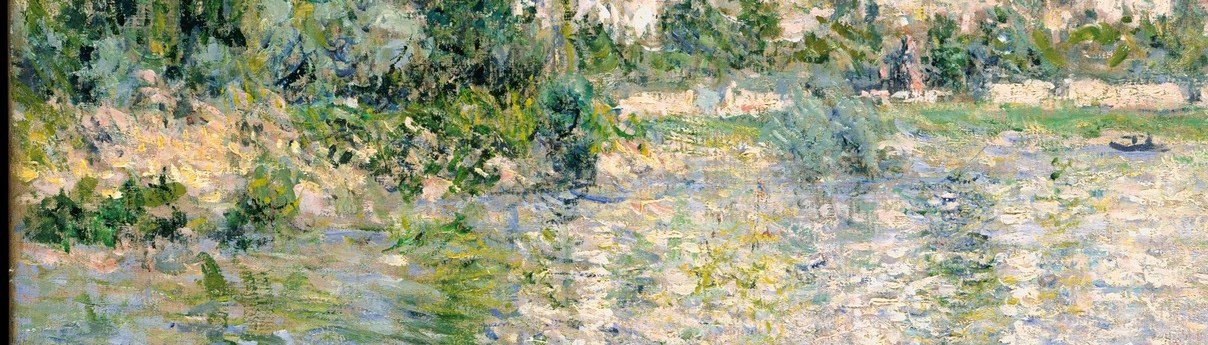
The thickest paint sits in the foreground water, where Monet dragged his brush through wet pigment to make the current visible. Further out, the shimmer on the mid-river surface is built from pure pale blues and whites, broken dabs that read as blinding summer sunlight on moving water. The painting argues that the reflection is as real, and as beautiful, as the village itself.
Details

Transcript
Summer, 1880. The Seine at Vétheuil. The village is named by its church tower. That tower was a landmark for river pilots. Monet lived here with his family, in a house on this road. Two figures in a rowboat, small against the current. They are the only people. The river belonged to work, not leisure. But look at the water itself: painted so thickly you can feel the current. Monet was trying to paint the light of one exact hour.