Self-Portrait with Waroquy by Édouard Vuillard
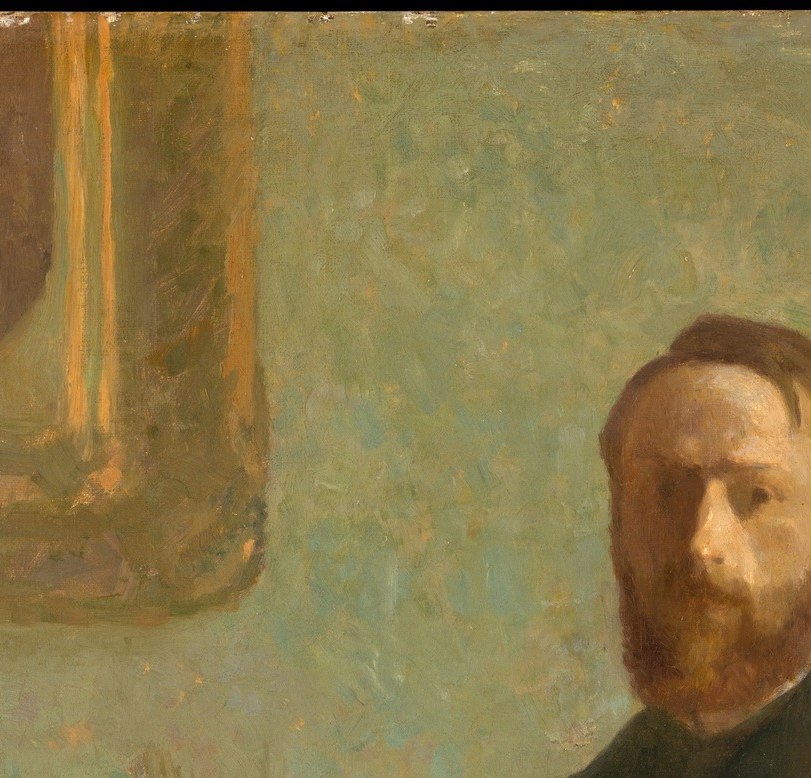
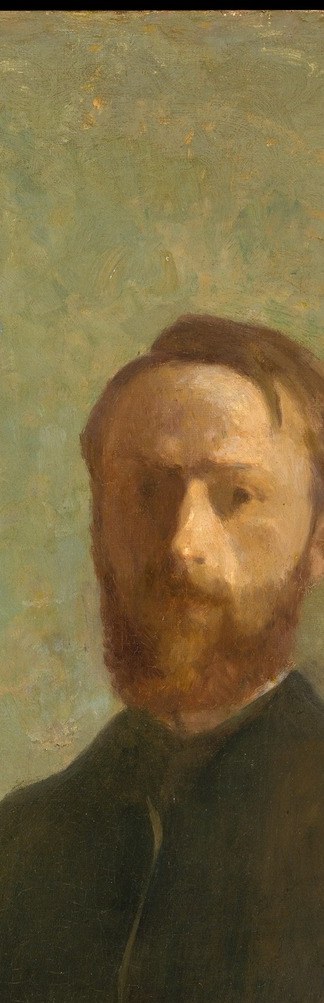
This is Édouard Vuillard's *Self-Portrait with Waroquy*, painted in 1895 and held by The Metropolitan Museum of Art. The title says self-portrait, but Vuillard makes a quiet, radical argument: that a self is not easy to separate from a room, a friend, or a shadow.
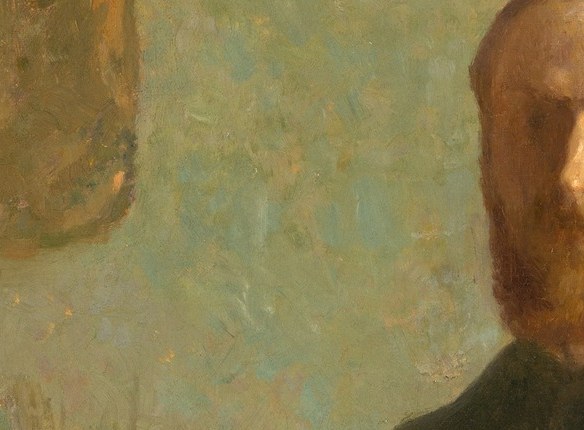
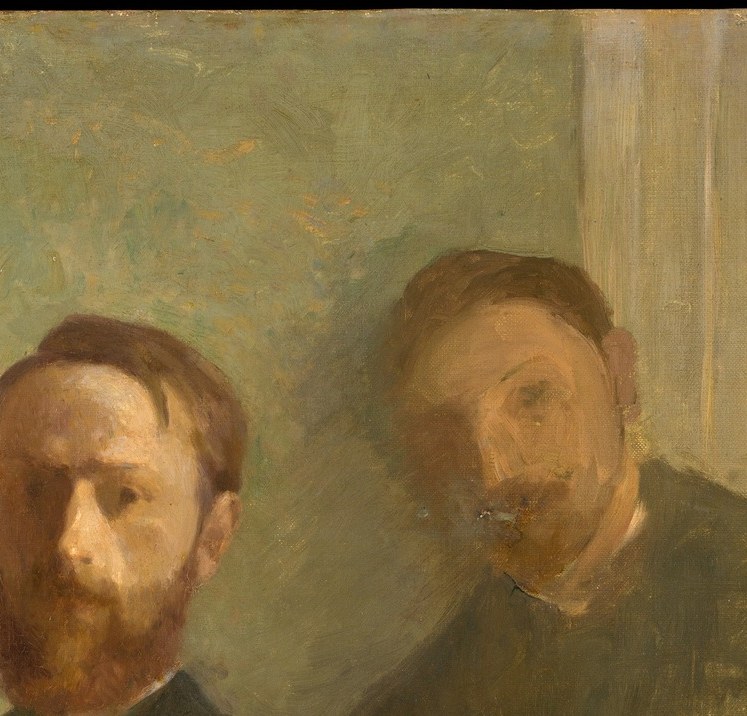
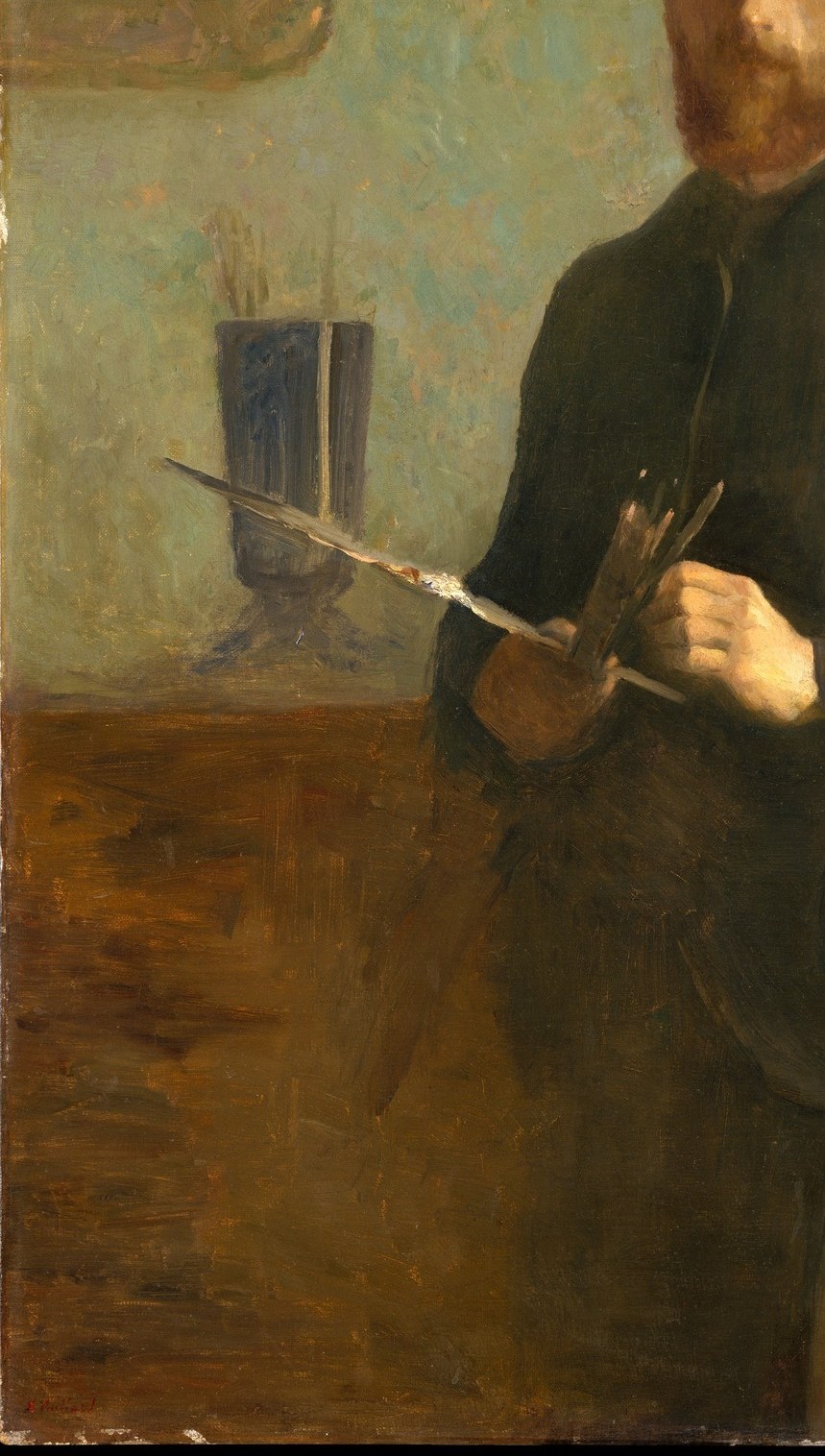
Look at the two faces. Vuillard, in front, is rendered with more solidity, his reddish beard catching a little warmth. But Waroquy, behind him, is a spectral smear, barely more present than the studio wall. Vuillard applied the same logic to his own body: his coat is near-black, blending into the darkness that eats the lower half of the picture. Only the pale palette and the brushes in his hands break through.
Vuillard was 27 and deep inside Les Nabis, a group of French avant-gardists who treated a painting not as a window onto a scene but as a flat surface of pattern and memory. Their influence here is Japanese ukiyo-e prints, which taught them that a figure could dissolve into decoration. Waroquy is not a ghost, he is a shape remembered inside a room the painter knew by heart.
The painting rewards patience. Tucked into the lower right is a cut-glass bottle, the only place in the picture where light refracts with any precision. Above left, a tiny framed rectangle, perhaps another canvas, hangs as a quiet clue that we are inside a studio. This is a painting about looking, and what gets lost when you do not.
Details
Transcript
A painter. A friend. A dark room. Vuillard painted this at 27, in the thick of the Nabi years. His face is solid. His beard: the only warm thing in the room. Now look at the other man. He is nearly gone. Vuillard painted himself fading too. His coat dissolves into the wall. Two men absorbed by the dark. The only thing he painted clearly: the tools.