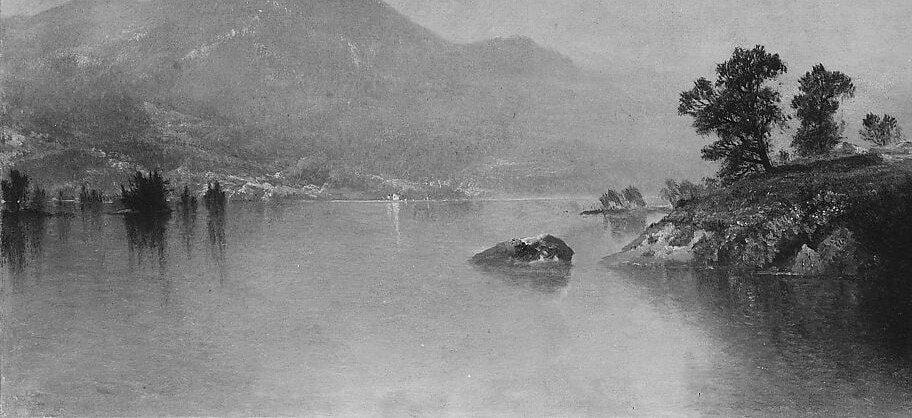
Lake George, New York by John Frederick Kensett
John Frederick Kensett's Lake George, New York (1872) is one of the last paintings he ever made, and it contains a tiny detail that changes everything.
Kensett was a master of Luminism, a style that prized atmosphere over action. Here the water is so still, so carefully blended, that sky and lake nearly merge into a single pale band at the horizon. The mountains are soft, the air is quiet, and the whole scene feels suspended in early morning silence.
Then, near the dead center of that mirror-flat lake, Kensett placed a dark speck. It may be a skiff, or a small islet, the form is deliberately ambiguous. But that one minute mark does something remarkable: it gives scale to the entire landscape. Without it, the view is infinite and impersonal. With it, you understand how vast the water really is, and a human presence is implied in all that stillness.
Kensett co-founded the Metropolitan Museum of Art and spent decades returning to Lake George, painting it again and again as his style grew quieter and more refined. This canvas, now at the Met, stands as his final word on the subject, a landscape so restrained that a single dark stroke becomes the key to everything.
Details


Transcript
A lake so still it mirrors the sky perfectly. Kensett painted this in 1872, the last year of his life. His brushwork is nearly invisible, even up close. He returned to this exact lake for decades. Now look at the center of the water. A tiny dark shape floats alone on the glass. It may be a skiff. One small mark gives the whole view its scale.