East Hampton Meadows by George Henry Smillie (American, 1840–1921)
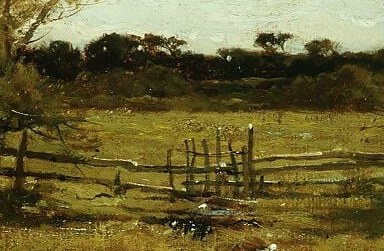
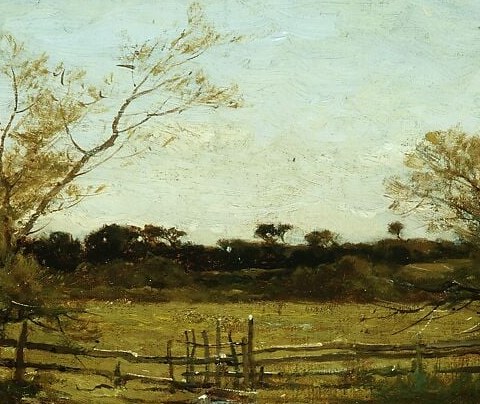
George Henry Smillie painted East Hampton Meadows in 1883, and what he recorded was a working agricultural landscape on the brink of transformation. The oil on canvas captures a specific place at a specific moment: open fields, split-rail fencing, and a quiet autumn sky over Long Island farmland. The painting now belongs to a private collection, but its documentary value is public. This is East Hampton before the Gilded Age summer colonies, before the oceanfront mansions, when the South Fork was still a place of pasture and salt marsh.
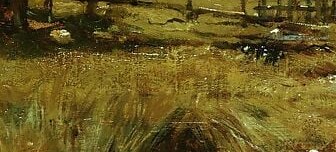
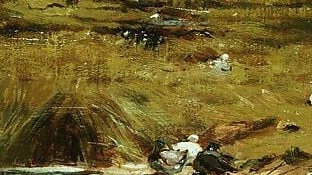
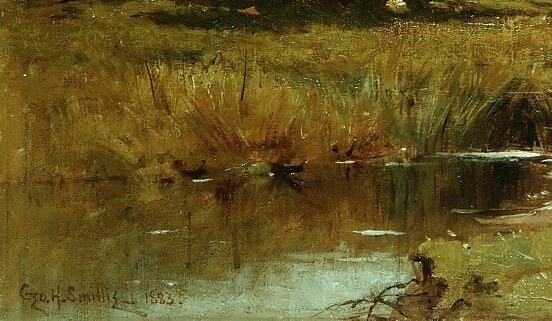
The painting rewards slow looking. Follow the diagonal fence line from left to right and you pass through an open wooden gate into the deeper fields. A dark mud track beneath the gate tells you this is livestock country. Two white birds, almost certainly egrets, feed at the edge of a still pool in the foreground, the sharpest point of contrast in the whole composition. Overhead, bare skeletal branches against a pale sky confirm the season is late autumn.
Smillie was part of a generation of American painters who left the studio to work en plein air, capturing immediate effects of light and weather. In East Hampton Meadows his brushwork stays loose and responsive, especially in the tawny meadow grasses that fill the lower third of the canvas. You can feel the painter standing there, working quickly as the afternoon light shifted from pale blue to a soft pink at the horizon.
Ten years later, the Long Island Rail Road would extend service to Bridgehampton, and everything would change. Smillie's quiet, unheroic scene is an eyewitness to a vanished agricultural world. What do you think the same view looks like today?
Details
Transcript
East Hampton, 1883. This is not a beach town yet. Split-rail fences divide the meadows into working pasture. The gate stands open. Livestock have passed through here all day. A worn mud track leads the eye toward the far fields. Two egrets feed at the water's edge. Smillie painted them from life. Look at the skeletal trees. Late autumn, no leaves left. The painter worked outdoors, on the spot, in the cooling air. Within a decade, the same fields would be mapped for summer cottages.