Dolls’ House of Petronella Oortman by Jacob Appel (I)
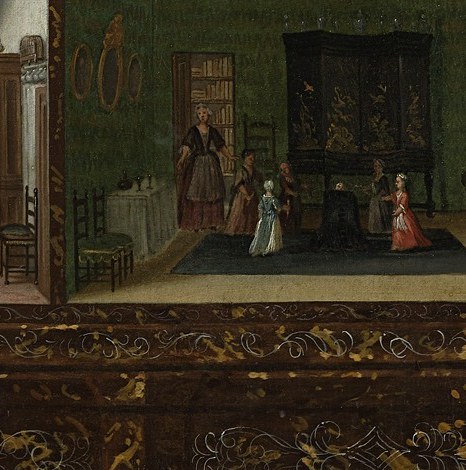
Jacob Appel's "Dolls’ House of Petronella Oortman," painted in 1710, isn't a miniature house itself, but a meticulously rendered painting on parchment, held at the Rijksmuseum.
This incredible work captures the intricate world of an 18th-century dollhouse. Notice how Appel uses fine brushwork and delicate shading to create the illusion of depth and reality within each tiny room. Every figure, every piece of furniture, and even the subtle shadows contribute to making this miniature world feel remarkably lifelike.
During the Dutch Golden Age, dollhouses were status symbols for affluent households. Appel translated this private pastime into a public artwork, showcasing both domestic virtue and the era's fascination with detailed representation. His training under masters like Timotheus de Graaf and David Van der Plaas, and later influence by Albert Meijeringh, are evident in the precision and light of this piece.
What detail in this painted dollhouse surprised you the most?
Details
Transcript
This isn't a real house, but a painting of a dollhouse. Look at the tiny figures inside each of its nine rooms. Each figure is painted on parchment, no bigger than your thumbnail. The painter used precise brushwork to create crisp outlines. Every object, from vases to furniture, feels perfectly real. Even the shadows inside are rendered with delicate shading. This masterful illusion was created by Jacob Appel in 1710.