Panoramic Landscape near the River Moselle by Rousseau, Théodore
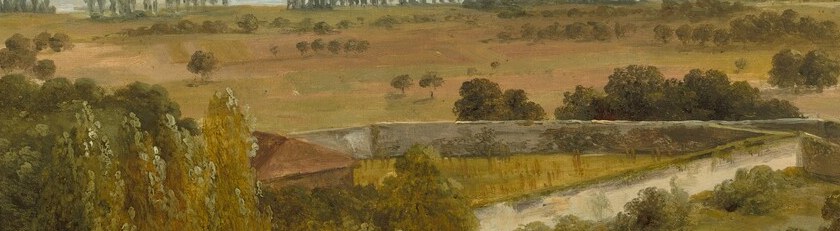
This is Théodore Rousseau's 'Panoramic Landscape near the River Moselle,' painted around 1830. Rousseau was not yet the leader of the Barbizon School when he made this. He was a young painter walking the French countryside, determined to capture light and weather exactly as they appeared, not as studio convention dictated.
Look at that single farmhouse in the middle distance. It is the only building for miles. Against the sweep of the valley, its smallness is the whole point. Then watch how the cloud shadows move across the plain, those cooler patches were painted wet-on-wet, a fleeting meteorological moment fixed in oil. Rousseau paid as much attention to a moving shadow as history painters paid to a general on a horse.
In 1830, the valley would have been quiet. No railways, no factories, just the river threading the fields. Maps of the period confirm farm clusters at the horizon exactly where Rousseau placed them. The painting is a document as much as it is a picture, a witness statement from a lost morning beside the Moselle.
Next time you see a wide landscape, try spotting the one thing that tells you human beings actually live there.
Details




Transcript
The year is about 1830. No railway has reached this part of France. The Moselle runs flat through the valley floor, catching the light. A single farmhouse stands in the middle distance. The painter walked out into this field and opened his easel. A cloud shadow crosses the plain. He painted it as it moved. He would later be called the father of French landscape painting.