Spanish Peaks, Southern Colorado, Late Afternoon by Samuel Colman (American, 1832–1920)
View the artwork: Spanish Peaks, Southern Colorado, Late Afternoon →
Samuel Colman's "Spanish Peaks, Southern Colorado, Late Afternoon" (1887) is a landscape of deliberate restraint. Rather than the dramatic peaks and crashing waterfalls that had defined much of the Hudson River School, Colman offers a painting built around emptiness: a vast ochre plain, a calm river, and two distant purple mountains under a fading sky.
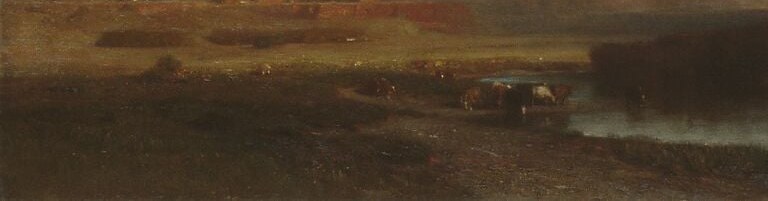
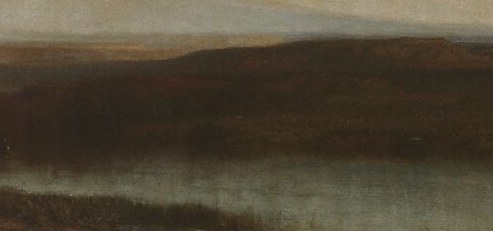
Look first at the foreground. Colman devotes nearly a third of the canvas to bare, featureless earth, a bold compositional gamble that communicates the solitude of the high plains. The eye then travels across rolling foothills, past a thin band of dark mid-ground trees, and finally rests on the Spanish Peaks themselves, veiled in an atmospheric purple haze that conveys enormous distance with almost no visible brushwork. A handful of tiny cattle at the river's edge are easy to miss, but essential; they establish the scale, making the mountains feel immense and the plain truly empty.
Colman painted this work after traveling through Colorado by train, a journey that gave him direct access to a landscape most Eastern audiences had never experienced. Born in 1832, he was a second-generation Hudson River School painter and a writer, carrying the tradition of American landscape into a new territory. This canvas functioned as a visual bridge, transporting the quiet, undramatic grandeur of the West to city dwellers in New York.
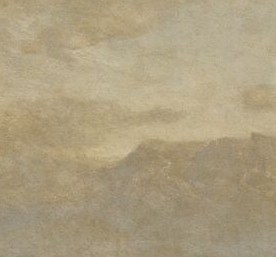
The painting lives in its sky, which shifts from a cool gray-blue overhead to a slender band of warm amber along the horizon. That hidden light gilds the peaks' lower flanks and ignites a calm pocket of reflection in the river on the right. It is a painting that asks you to stop, breathe, and sit with the silence.
#arthistory #hudsonriverschool #samuelcolman
Details


Transcript
Eastern audiences had never seen anything like this. Two purple peaks, a river, and almost total silence. Samuel Colman took a train through Colorado in 1887. He came back to New York with this. Notice the foreground. It is almost empty. Colman gives a third of the canvas to bare earth. The only sign of life is those small cattle by the river. He was not painting a place. He was painting how it felt to be alone in it.