Lot and His Daughters [reverse] by Dürer, Albrecht
This is Albrecht Dürer's Lot and His Daughters [reverse], painted around 1496 to 1499. It is now in the collection of the National Gallery of Art in Washington, D.C. Dürer captures a rarely-painted beat in the biblical narrative: the frantic escape itself, rather than the cave scene that followed. The artist was still in his mid-twenties when he painted this panel, experimenting with how oil paint could build dramatic light and shadow.
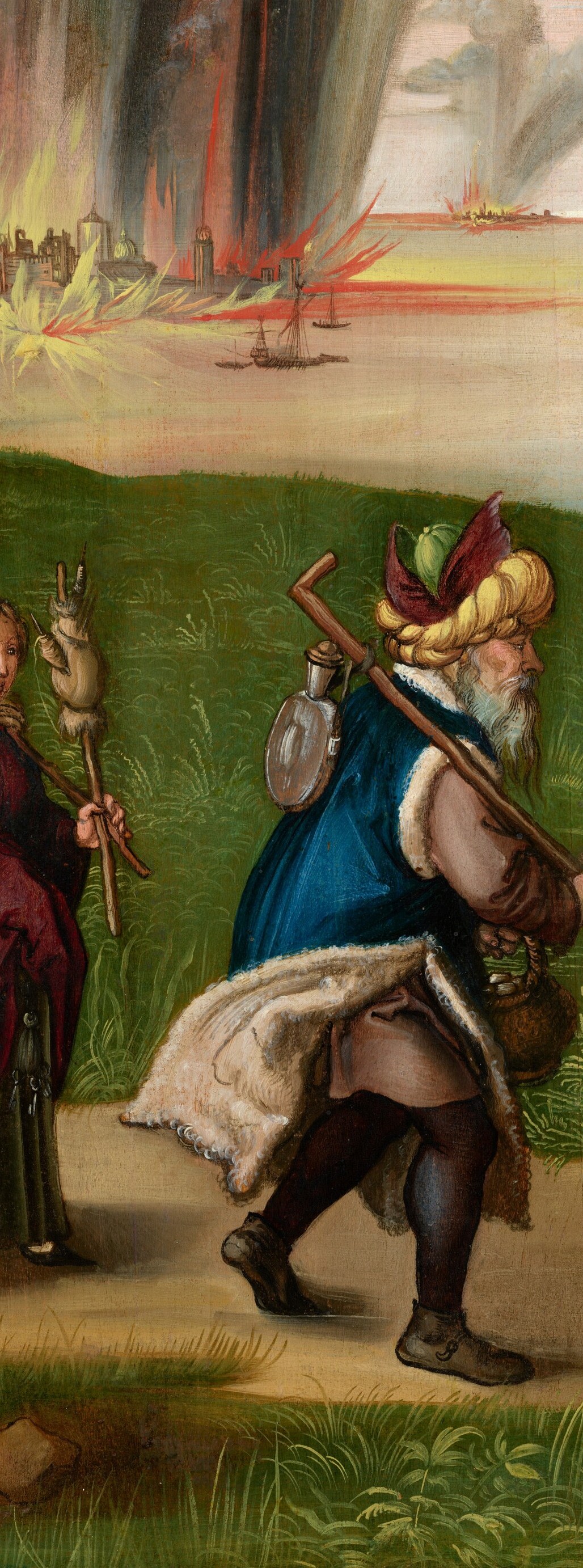
The composition pushes the family forward toward an uncertain open plain. The eldest daughter, in her saturated red dress and blue headcloth, anchors the group. She looks ahead resolutely. Lot, in dark cloak and stooped posture, turns his face backward toward the burning city. The orange glow of Sodom's destruction is the only warm light in the distance, everything else is cool and clear.
The story comes from Genesis. As Sodom and Gomorrah were destroyed, Lot and his daughters fled. His wife looked back and became a pillar of salt. Here, Lot's backward glance holds a tension: he looks, but he survives. The daughters carry bundles, a basket, and small domestic objects, ordinary life smuggled out of apocalypse. A small animal crouches at the lower left corner, escaping the same doomed city.
Dürer was a master observer, and even in a biblical scene he insisted on botanical detail in the foreground vegetation. The living earth is indifferent to human catastrophe, which only makes the family's escape feel more precarious.
Details



Transcript
The city of Sodom burns in the distance. One man has survived with his daughters. Look at the man's face. He is still turned back toward the fire. His wife looked back and turned to salt. But his daughters look only forward. They carry the future on their shoulders.